Author: Tom Brown
Written by the well-known activist and propagandist Tom Brown, this text explains clearly the principles according to which syndicalist unions organise, and the new society they aim to create “within the shell of the old”.
Author: Tom Brown
Written by the well-known activist and propagandist Tom Brown, this text explains clearly the principles according to which syndicalist unions organise, and the new society they aim to create “within the shell of the old”.
Author: Dónal O Driscoll
While there is a tradition of grassroots campaigning against racism in Ireland, there is less discussion of what it means to be an anti-racist from an anarchist perspective. Most material focuses on obvious forms such as hate-speech or supporting Travellers & migrants in practical terms. The issue this article seeks to raise is that in order to get it right we also need to look at ourselves on a personal level, recognise privilege and develop a wider critique that is truer to our own politics.
Author: Aidan Rowe
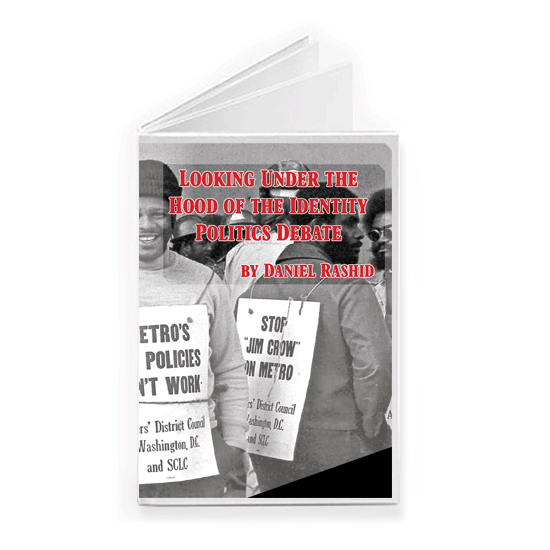
As class-struggle anarchists dealing with the relations between gender, race and class, we must, in theory and practice, pick a path between two pitfalls. On one side is economic reductionism – the reduction of all political questions to the social relations of production – which erases the perspectives and struggles of women, queers and people of colour; submerges their voices within an overly generalised class narrative, in which the idealised Worker is implicitly white heterosexual and male; or consigns their struggles to a secondary importance compared to the “real struggle” of (economic) class against class. On the other is a stultifying and inward-looking liberal-idealist identity politics, concerned fetishistically with the identification of privilege and the self-regulation of individual oppressive behaviour to the (near) exclusion of organised struggle, which, while amplifying the voices of the marginalised, consigns them to an echo chamber where they can resonate harmlessly….
Author: Thomas (Miami Autonomy & Solidarity)
As anarchist communists, we are against reformism. However, we are for reforms. We believe that fundamentally the entire system of capitalism, the state and all systems of hierarchy, domination, oppression and exploitation of humans over humans must be abolished and replaced with a direct democracy, egalitarian social relations and a classless economy that bases contribution according to ability and distribution according to need. However, such a social revolution can only occur through the power of the popular classes themselves from the bottom-up. In advancing towards such a social revolution and a free and equal society, we must build our power in preparation for this fundamental transformation of the world, building on struggles along the way….
Author: Scott Rittenhouse
Urban Planning is neither boulevards for conquerors, nor a landscape for the palaces of the rich, nor an opportunity for land speculators, nor a design opportunity for artists, nor a conspiracy for social engineers.
Urban planning is conducted to promote the health, safety, and well-being of people living together in urbanized areas; to enable people in urbanized areas to use scarce resources efficiently (all natural resources are “scarce”: supply and demand equals scarcity); and to mitigate the impact of population growth on the health of the planet.
Under capitalism, planning has been used to service the interests of the rich who own property [real estate] and the means of production. Under Anarchism, these will be “socialized”: expropriated, collectively “owned” by the Free Commune / Community, used and self-managed by workers and residents, non-transferable, and non-saleable. People will be able to make the land use decisions which meet their needs and make their lives better. There will be no “property values” or land speculation….
Author: Scott Nappalos
The terrain is changing beneath our feet. Since the collapse of the majority of the “official Communist” regimes, the world has witnessed both events and ideas that have undermined the former dominant thinking within the left. The Zapatistas, Argentina in 2001, South Korean workers movements, Oaxaca in 2006, the struggles around anti-globalization, and Greece’s series of insurrectionary moments have increasingly presented challenges to traditional left answers to movements and organisation. In previous eras Marxist-Leninism was the nexus which all currents by default had to respond to either in agreement or critique. Today, increasingly anarchist practices and theory have come to play this role.
As a member of an anarchist political organisation, a friend once told me I in fact was practicing democratic centralism. This was perplexing, because the group had no resembling structures, practices, or the associated behaviours of democratic centralism….
Author: Adam Weaver
Where can those looking for a critical understanding of Lenin turn? How can we better understand how the Russian Revolution began as the first modern anti-capitalist revolution from below with workers taking over and running their workplaces, peasants seizing the land, and the creation of democratic soviets (worker committees)? And then in less than a decade its devolution into the brutal dictatorship of Stalin? Is there a continuity between the ideas of Lenin and his particular brand of Marxism that reshaped the Marxist movement in the 1920’s and the number of revolutionary parties that would later achieve state power and claim the Bolshevik party and Lenin as their model and inspiration?