Building a Revolutionary Anarchism

Building a Revolutionary Anarchism - Colin O’Malley

Author: Colin O’Malley

File size: 384 KB

Download PDF

This article speaks on the failures of the anarchist movement to grow, despite numerous social movements, and how models of anarchist political organisation point the way forward to overcome these pitfalls.

Two recent events have thrown critical challenges at the anarchist movement in the United States: the financial crisis that began in 2008 and the Occupy Wall Street (OWS) movement that sprung from that crisis in 2011. If the current political and economic outlook in this country is any indication, we should expect more frequent moments like these to arise. “Movement Moments” such as these are critical opportunities for revolutionaries of any variety, left or right. Acceptance of the status quo seems impossible.

This piece originally appeared in Perspectives on Anarchist Theory, No. 27 (2014) published by the Institute for Anarchist Studies.

Continue reading

The Principles of Anarchism

The Principles of Anarchism - Lucy Parsons

Author: Lucy Parsons

File size: 321 KB

Download PDF

A lecture by Lucy Parsons, in which she
outlines her views on anarchism.

It was during the great railroad strike of 1877 that I first became interested in what is known as the “Labour Question.” I then thought as many thousands of earnest, sincere people think, that the aggregate power, operating in human society, known as government, could be made an instrument in the hands of the oppressed to alleviate their sufferings. But a closer study of the origin, history and tendency of governments, convinced me that this was a mistake; I came to understand how organised governments used their concentrated power to retard progress by their ever-ready means of silencing the voice of discontent if raised in vigorous protest against the machinations of the scheming few, who always did, always will and always must rule in the councils of nations where majority rule is recognised as the only means of adjusting the affairs of the people. I came to understand that such concentrated power can be always wielded in the interest of the few and at the expense of the many. Government in its last analysis is this power reduced to a science. Governments never lead; they follow progress. When the prison, stake or scaffold can no longer silence the voice of the protesting minority, progress moves on a step, but not until then.

Continue reading

AgitProp #19 – Anarchism and Crime

AgitProp #19 - Anarchism and Crime - SolFed

Author: Solidarity Federation

File size: 206 KB

Download PDF

Anarchists are repeatedly accused by our detractors of being idealist, utopian and impractical. One matter, on which the libertarian perspective is often seen as particularly weak, is the thorny topic of crime. It would be fair to say that the “all coppers are bastards”-type polemics trotted out with tiresome regularity do little to convince the potential convert that revolutionaries have anything of substance to offer as an alternative to the crime ridden status quo. Moreover, this continued failure to adequately address lay people’s basic questions with satisfactory answers surely goes a long way in explaining why contemporary anarchism has failed to gain a firm foothold in the collective psyche of the population. Here we offer one contribution towards addressing this perennial shortcoming.

From Direct Action, Issue #46, magazine of the Solidarity Federation
www.direct-action.org.uk

Continue reading

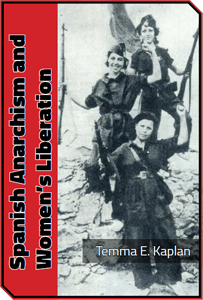
Spanish Anarchism and Women’s Liberation

Spanish-Anarchism-and-Womens-Liberation-Temma-E-KaplanAuthor: Temma E. Kaplan | File size: 291 KB

Download PDF

One of the chief ideological disputes between the Spanish anarchists and communists during the Civil War was the anarchists’ insistence that social revolution should not be postponed until the war was won; without the social revolution (by which they meant the defeat of authoritarianism and the transformation of all social and economic relations and institutions to permit maximum individual freedom, self-expression, and spontaneity), the war would be just another changing of the guard, so familiar in Spanish history.

Source: Journal of Contemporary History,
Vol. 6, No. 2 (1971), pp. 101-110.
Originally found at: the Zine Library, http://zinelibrary.info/
(attempted access on 12 September 2015, showed the site to be down)

Continue reading

[Leaflet] Thinking about Anarchism: What is Anarchism? – John Flood

[Leaflet] Thinking about Anarchism: What is Anarchism? - John FloodAuthor: John Flood | File size: 111 KB

Download PDF

Many people still associate anarchism with violence, destruction, and chaos. This concept of anarchism is reinforced by the corporate media, and those that have an interest in discrediting the anarchist movement. Needless to say this idea of anarchism bears no correlation with the society we are trying to create, or our struggle to achieve it.

From Workers Solidarity, the magazine of the Irish Workers Solidarity Movement

Continue reading

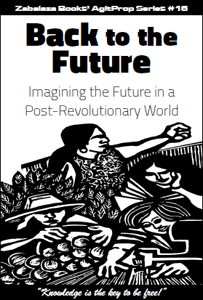
AgitProp #16 – Back to the Future: Imagining the Future in a Post-Revolutionary World

AgitProp #16 - Back to the Future: Imagining the Future in a Post-Revolutionary WorldAuthor: Unknown | File size: 356 KB

Download PDF

Much of our time as revolutionaries is spent on the routine of organising in the here and now – building a campaign, organising for a demonstration, planning for a trade union meeting…. Too often we don’t manage to take time to step back from the here and now and imagine or envisage what it’s all about. But without dreaming, without imagining a future the daily humdrum can seem dispiriting.

To really build for a new society, we need to try to paint a picture of what that society might look like. And we need to be able to suspend reality and dream of the sort of future that might be out there. This article is the first of what we hope will be a series which will attempt to look into a post-revolutionary future and imagine what such a society might look like.

Read and dream….

This article is from Issue 3 of the Irish Anarchist Review – published May 2011

Continue reading

Socialism from Below: Defining Anarchism

Socialism from Below: Defining Anarchism by Lucien van der Walt and Michael SchmidtAuthors: Lucien van der Walt and Michael Schmidt | File size: 759 KB

Download PDF

This pamphlet is Chapter 2 of the book Black Flame: The Revolutionary Class Politics of Anarchism and Syndicalism (Counter-Power vol. 1) by Lucien van der Walt and Michael Schmidt. All references to other chapters throughout this text are references to that book.

See: black-flame-anarchism.blogspot.com

Continue reading

Marxism, Freedom and the State

Marxism, Freedom and the State - Mikhail BakuninAuthor: Mikhail Bakunin | File size: 478 KB

Download PDF

Liberty for all, and a natural respect for that liberty: such are the essential conditions of international solidarity.

~ Bakunin

This collection of extracts from the works of Mikhail Bakunin are taken from his writings touching on his controversy with Marx over the nature of the state and its role in the liberation of the international working class.

Written between 1867 and 1872, many of Bakunin’s predictions about the outcome of following the authoritarian communist road have been proven valid by the actions of Leninist tyrants across the world.

Text from LibCom | libcom.org

This second Zabalaza Books edition July 2014

Continue reading

Taking Account of our Politics: An Anarchist Perspective on Contending with Sexual Violence

Taking Account of our Politics: An Anarchist Perspective on Contending with Sexual Violence by Common CauseAuthor: Common Cause | File Size: 313 KB

Download PDF

In the fall of 2010, several female members of Common Cause took on the task of developing a sexual violence policy for the organization. At the time, and as far as we were aware, there had never been an instance of sexual violence in Common Cause. Our drive to write the policy came from some members’ past experiences of being sexually assaulted while participating in other organizations, from a desire to do better, and from our own readings on sexual violence and accountability processes generally. Since then, we have, unfortunately, had to make use of the policy to address issues of sexual violence as an organization. There have been situations in which our members have been sexually assaulted, situations where members have been aggressors, and situations outside our organization where we have been asked or felt compelled to offer our perspective…..

This text is from Volume 2 of Mortar: Revolutionary Journal of
Common Cause Anarchist Organization | Linchpin.ca

Continue reading

Bourgeois Influence on Anarchism: Redux

Bourgeois Influence on Anarchism: Redux - Common CauseAuthor: Common Cause | File Size: 338 KB
Download PDF

Reading Luigi Fabbri today, an anarchist of the revolutionary communist bent in Canada may feel a sense of smug satisfaction coupled with a dash of arrogant resentment. The way he set his sights on the debasement of our political tradition might have us thinking we’re reading the words of a kindred spirit. How very accurate and tragically humorous his polemic feels to us. All the more because it was penned nearly a century ago. However, have we really earned the self-satisfied head nodding and chuckles that accompany our reading of Bourgeois Influence on Anarchism? Fabbri took to task the growing sentiment within the anarchist tradition that glorified the outlaws, bombers, and assassins of his day. We read on with our own anarcho-rogues gallery of anti-organizationalists, black bloc puritans, and deep green resisters playing in our head. But are these really the contemporary correlatives of bougiefied anarchism?…

This text is from Volume 2 of Mortar: Revolutionary Journal of
Common Cause Anarchist Organization | Linchpin.ca

Continue reading

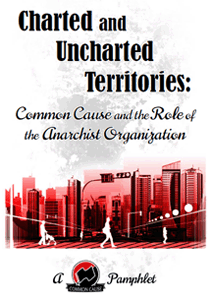
Charted and Uncharted Territories: Common Cause and the Role of the Anarchist Organization

Charted and Uncharted Territories: Common Cause and the Role of the Anarchist Organization - Common CauseAuthor: Common Cause  |  File Size: 415 KB

Download PDF

These days, the phrase “anarchist organization” is widely seen as a contradiction of terms. For those whose opinions of anarchism are shaped by dominant society, this is perfectly understandable. In the crude caricature fashioned by capitalist media depictions and reinforced through popular culture, anarchy is synonymous with chaos, spontaneous violence, and a vicious, Hobbesian state of nature.

However, more pertinent to us is that even within anarchist circles, the idea of an anarchist organization is often seen either as an oxymoron, or more commonly, as an inherently authoritarian structure somewhat akin to a Leninist cult. And as anarchists who have derived considerable practical benefits from our participation in a formally structured organization, we feel that much of this confusion boils down to a misunderstanding of terms and history. …

This text is from Volume 2 of Mortar: Revolutionary Journal of
Common Cause Anarchist Organization | Linchpin.ca

Continue reading