![[Poster] I demand the independence of woman by Emma Goldman](https://zabalazabooks.net/wp-content/uploads/2015/06/poster-i-demand-the-independence-of-woman-emma-goldman.gif?w=676)
Click above picture to download A4 poster
Click above picture to download A4 poster
 Author: Common Cause | File Size: 347 KB
Over the course of the last several decades, anti-oppression politics have risen to a position of immense influence on activist discourse in North America. Anti-oppression workshops and reading groups, privilege and oppression checklists and guidelines, and countless books, online blogs and articles make regular appearances in anarchist organizing and discussion. Enjoying a relatively hegemonic position in Left conversation, anti-oppression politics have come to occupy the position of a sacred object—something that expresses and reinforces particular values, but does not easily lend itself to critical reflection. Indeed, it is common for those who question the operating and implications of anti-oppression politics to be accused of refusing to seriously address oppression in general. A political framework should be constantly reflected upon and evaluated—it is a tool that should serve our struggles and not vice versa….
This text is from Volume 2 of Mortar: Revolutionary Journal of
Common Cause Anarchist Organization | Linchpin.ca
 Author: Common Cause | File Size: 313 KB
In the fall of 2010, several female members of Common Cause took on the task of developing a sexual violence policy for the organization. At the time, and as far as we were aware, there had never been an instance of sexual violence in Common Cause. Our drive to write the policy came from some members’ past experiences of being sexually assaulted while participating in other organizations, from a desire to do better, and from our own readings on sexual violence and accountability processes generally. Since then, we have, unfortunately, had to make use of the policy to address issues of sexual violence as an organization. There have been situations in which our members have been sexually assaulted, situations where members have been aggressors, and situations outside our organization where we have been asked or felt compelled to offer our perspective…..
This text is from Volume 2 of Mortar: Revolutionary Journal of
Common Cause Anarchist Organization | Linchpin.ca
 Authors: Abbey Volcano and J. Rogue | File size: 332 KB
A critique of liberal conceptions of ‘intersectionality’ and an outline of an anarchist, class struggle approach.
Found at:www.anarchistaffinity.org | www.libcom.org
 Author: Anarchist Federation | File size: 236 KB
This article will be a very basic introduction to the foundations of safer spaces, community accountability and transformational justice that arise from elements present from the very inception of anarchism as a political philosophy. These concepts are responses to verbal, physical and sexual abuse that have always been present within radical communities and continue to present a challenge to this day. As such this article will touch on all forms of abuse from problematic language through to rape and physical violence. An example of one such policy can be seen at http://bit.ly/1207uq8
This article was first published in the Anarchist Federation’s
Organise! magazine #80, Summer 2013.
 Author: Aidan Rowe | File size: 886 KB
As class-struggle anarchists dealing with the relations between gender, race and class, we must, in theory and practice, pick a path between two pitfalls. On one side is economic reductionism – the reduction of all political questions to the social relations of production – which erases the perspectives and struggles of women, queers and people of colour; submerges their voices within an overly generalised class narrative, in which the idealised Worker is implicitly white heterosexual and male; or consigns their struggles to a secondary importance compared to the “real struggle” of (economic) class against class. On the other is a stultifying and inward-looking liberal-idealist identity politics, concerned fetishistically with the identification of privilege and the self-regulation of individual oppressive behaviour to the (near) exclusion of organised struggle, which, while amplifying the voices of the marginalised, consigns them to an echo chamber where they can resonate harmlessly….
This article is from the Workers Solidarity Movement’s Irish Anarchist Review, No. 7 – Spring 2013
![[Leaflet] Solidarity against Sexism on the Shop Floor](https://zabalazabooks.net/wp-content/uploads/2012/10/leaflet_solidarity_against_sexism_on_the_shop_floor_angel_gardner.gif?w=676 "[Leaflet] Solidarity against Sexism on the Shop Floor") Author: Angel Gardner | File size: 81.5 KB
Author: Angel Gardner | File size: 81.5 KB
If there is anything that I have learned from working in the restaurant and retail industry for over 14 years, it is that sexual harassment and sexism in the workplace is an issue that has not gone away. Perhaps you have become more tolerant of being sexually objectified. Maybe you are afraid that being uncomfortable with sexual advances or comments means that you are a prude or hopelessly outdated. The reality is that sexual harassment and sexism are all about power. We feel uncomfortable about standing up for ourselves in these situations because to do so questions power relations; not only in the workplace, but in society in general….
This article originally appeared in the Industrial Worker, the paper of the IWW
 Author: Hana Plant | PDF file size: 255 KB
“I write this story to build connections between class struggle and feminism, so that the lives of working class women are illuminated, part of the political framework. … To me, the famed feminist saying ‘the personal is political’ is not so much about changing our own lives to change the world, but a theoretical framework that affirms the value of our stories and uses the patterns between them as a basis for solidarity…”
 Authors: Barbara Ehrenreich and Deirdre English | PDF file size: 817 KB
Women have always been healers. They were the unlicensed doctors and anatomists of western history. They were abortionists, nurses and counsellors. They were pharmacists, cultivating healing herbs and exchanging the secrets of their uses. They were midwives, travelling from home to home and village to village. For centuries women were doctors without degrees, barred from books and lectures, learning from each other, and passing on experience from neighbour to neighbour and mother to daughter. They were called “wise women” by the people, witches or charlatans by the authorities. Medicine is part of our heritage as women, our history, our birthright.
Today, however, health care is the property of male professionals. Ninety-three percent of the doctors in the US are men; and almost all the top directors and administrators of health institutions. Women are still in the overall majority — 70 percent of health workers are women — but we have been incorporated as workers into an industry where the bosses are men. We are no longer independent practitioners, known by our own names, for our own work. We are, for the most part, institutional fixtures, filling faceless job slots: clerk, dietary aide, technician, maid….
“To know our history is to begin to see how
to take up the struggle again!”
 Author: Martha A. Ackelsberg | PDF file size: 665 KB
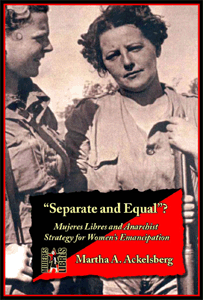
In May 1936, a group of anarchist women founded Mujeres Libres, the first autonomous, proletarian feminist organisation in Spain… Its goal was to end the “triple enslavement of women, to ignorance, to capital, and to men.” While some of the founders were professional or semi-professional women, the vast majority of its members (who numbered approximately 20,000 in July 1937) were working-class women. The women of Mujeres Libres aimed both to overcome the barriers of ignorance and inexperience which prevented women from participating as equals in the struggle for a better society, and to confront the dominance of men within the anarchist movement itself….
 Authors: Colin Wright & Howard J. Ehrlich | PDF file size: 230 KB
Pamphlet includes 2 texts: Anarchism, Feminism and the Individual by Colin Wright and Toward a General Theory of Anarcha-feminism by Howard J. Ehrlich
If there is anything that I have learned from working in the restaurant and retail industry for over 14 years, it is that sexual harassment and sexism in the workplace is an issue that has not gone away. Perhaps you have become more tolerant of being sexually objectified. Maybe you are afraid that being uncomfortable with sexual advances or comments means that you are a prude or hopelessly outdated. The reality is that sexual harassment and sexism are all about power. We feel uncomfortable about standing up for ourselves in these situations because to do so questions power relations; not only in the workplace, but in society in general.
The answer: If any of these policies, attitudes or behavior makes you feel uncomfortable, then you should not have to deal with it. Everyone’s comfort level is different. Some of your co-workers might not mind being called “girl” or “sweetie,” while others may take offense to being referred to as a “woman” or by any gender-specific pronoun. Different expectations for employee uniforms that force co-workers into stereotyped gender roles are sexist practices that create a potentially hostile workplace. Flirting with customers should never be a given, but a choice. Some people may find that they like the attention and get better tips by flaunting their appearance and flirting, but not everyone should have to interact in a similar fashion. Berating others for what makes them uncomfortable promotes an environment of harassment.
So you feel like a policy or an individual at work is creating a hostile work environment? Going the legal route is not always the best or solitary option. Collectively standing up together with your co-workers against sexist practices, policies or individuals can often be the safest and most powerful way to fight. Though it is technically illegal, it is easier for companies to retaliate against an individual than a group of workers. In addition, sexual harassment cases often result in companies dragging women through the mud and can prove to be very traumatic for the victim. Legal processes can take a long time to resolve, but taking direct action in your workplace is immediate. When workers come together to fight sexual harassment and sexism, we are empowered by taking back the workplace and at the same time, form closer bonds with our co-workers by building mutual trust and respect for one another.
This article originally appeared in the March edition of the Industrial Worker, the newspaper of the Industrial Workers of the World. It does a great job answering many questions relating to sexual harassment.
From: http://femenins.blogspot.de/2011/03/solidarity-against-sexism-on-shop-floor.html
 by Hana Plant
I write this story to build connections between class struggle and feminism, so that the lives of working class women are illuminated, part of the political framework. To do this, I have needed to write from a personal/political perspective. To me, the famed feminist saying ‘the personal is political’ is not so much about changing our own lives to change the world, but a theoretical framework that affirms the value of our stories and uses the patterns between them as a basis for solidarity. It suits many women (not all), because many of us have been socialised to focus on the ‘private’ realm: the home, emotions, close relationships. At the same time, because our concerns are not seen as valid, they are considered private. So personal stories, when woven together, allow us to come out of shame and assert the collective nature of something otherwise considered individual: domestic and sexual violence are good examples. The beauty of the personal is that it also honors our unique reality: no two stories are exactly the same. From what I can see, most class struggle theorising does not seek to overcome the division between the personal and the political. Most often, class focused literature and discussion describes and analyses the ‘public’ domain: current affairs, government, and the money economy. While I believe this kind of thing is important, I want room for writing that reflects the realities of women: the kind of things that affect us, as well as our way(s) of relating. So this is me looking at two of many power relationships, patriarchy and capitalism, from a personal/political perspective.
Earlier this year, something happened that interrupted my ability to carry on with the class struggle in a straightforward way. That is, my Dad and my 10-year-old sister came to visit and I saw, again, that she was being abused. Taken off her extremely abusive mother by CYFS, and put into the care of our father, she has already had a hard start. Of course, he is also abusive, but seeing she is not black and blue, CYFS wants the case closed. I’ve known what my Dad’s up to for ages. At a distance I know that it’s not in my control. But when I saw her in front of me, her hair full of nits, wearing fuck-me boots, and that tough, ravaged look in her eyes, I wanted more than anything to save her. I wanted to make her wear kids shoes so the bourgeois gaze, the male gaze, wouldn’t hurt her. I wanted to comb the nits out of her hair, so she wouldn’t be teased at school. I wanted to take the force of the blow, to put myself between her and him. This is a story of capitalist patriarchy, and why I want to build the solidarity we need to change it.
A lifelong beneficiary, my father is close to the bottom of capitalism’s heap. He is also a perpetrator of abuse (mostly physical and emotional). So the contradiction between feminism and class struggle is one I was raised with: sympathy with my father’s class predicament, fear and hatred for his misogyny. The idea that class is more important than feminism or vice-versa has never felt right for me, although sometimes I have gone along with other people’s priorities. Among anarchists, this prioritization occurs in practice rather than theory. I have been shut down on class in anarchist-feminist circles where the agreed understanding is that all oppression is interconnected. Likewise, I have been silenced in class struggle contexts where feminism is supposedly of utmost importance. Since we live in a patriarchal capitalist society, the contradictions between feminism and class struggle are present in the lives of all working class women, to varying extents. I tell a story from the rural underclass, where the collision of interests between working class men and women is dramatic.
My Dad is a first generation Pākehā born to immigrant parents, who, like most of their generation, were traumatised by the Second World War. Like most lower class women, Nana had to work both in and out of the home. Unlike most working class people at that time, this family did not leave the bush (Coromandel) to join the urban migration. Perhaps that’s why my Dad didn’t go to university for free and get a middle class job like many of his generation. Nor did he get any of the few working class jobs there are in Coromandel, where you can bust your back in the mussel factory or smile for tourists in a café all for minimum wage. Instead, he joined those who were left far behind, living off the dole, mutual aid, the bush and the sea. My Dad is astute enough to know the local workforce sucks for ‘unskilled’ workers, that he’s on the benefit not because he’s lazy but because he doesn’t want to be trod on. But he doesn’t put this knowing into a political context where he could resist with others in the same boat, for he does not have access to a movement that struggles against capitalism. Instead, he takes refuge in an underclass community where there is DIY culture, resistance to the police and a culture of story telling developed over years of smoking, fishing and drinking cups of tea together. Sounds pretty good eh?
This community is angry. They are angry because they have been raised by parents who were angry because of the war. They are angry because they did not rise, like the rest of the baby boomers, to a cushy lifestyle and an air of prestige. They are angry because although they work all day, fixing cars and cooking and looking after kids and fishing, they do not get paid. They are angry because they pay rent all year and have to move out over summer so the hippy landlords can have their place back for Christmas. They are angry because the only jobs open to them are those where they would be stood on by those higher up the hierarchy, the surplus value of their labour expropriated. They are angry because the only other options are the dole and/or drug dealing, which they are then hassled for. They are angry because they are positioned at the edge of so-called society, where they are either shunned, ignored or patronised.
This is a story of patriarchy. Patriarchy tells the men of this community that being on the dole is emasculation, and there’s nothing worse than that. Patriarchy says that a good way for men to feel their masculinity is by controlling women, that women are there to be controlled when you cannot control anything else. So communities like my father’s see women and children as receptacles for their pain and frustration. They push their anger out of themselves and into or onto our bodies. Then, when these men break down in tears of guilt afterward, patriarchy says that women are there to sympathise. Patriarchy says that we must hold their rage and our rage in our bodies until we crack: and if we crack patriarchal capitalism calls us mad (and there’s nothing worse than that). Patriarchy says that men should back each other up. So solidarity is practiced amongst men only. They tell each other that they did the right thing; the woman is a bitch, the child a spoilt brat. They tell each other that they do everything: catch the fish, bring in the extra dough, fix the car; that women and children should just be grateful.
While capitalism creates a society that causes rage and pain, capitalist ideology tells us that it is these men who cause all the problems, that these are the worst men. Their crimes should be publicised, laughed at, and condemned, while those of ruling and middle class men are kept hidden. And patriarchal capitalism tells us that the women are worse still. They are not real women because they do not protect their children. They are stupid for choosing to be with men like that when there are plenty more fish in the sea, but they could never get a good man because they look like trash. They are mad because every now and again they crack.
Yet while it’s easy for left-wing men to say that the ruling class causes all the trouble, most women know this is not true. The ruling class may pull the strings, but they do not touch us. I have not heard their words break my heart, felt their fists on my body, or seen them kick the shit out of a dog. The ruling class is part of the problem, but they are not the only ones who get something out of patriarchy.
While it’s easy for feminists and pro-feminists to say that these men should be left to rot, most of us who’ve been at their mercy don’t find that so easy. For us, there may not be plenty more fish in the sea, for we have scars that most ‘good guys’ (or girls) wouldn’t go near. Most of us love our home communities, and feel utterly displaced if we leave. We may have to leave to be safe, we may want to arm ourselves with an analysis of patriarchy, but that doesn’t mean we want these men to be called irredeemable, stupid or evil (unless it’s us doing the naming). Not only do we share class interests with my father; I also identify with those he abuses: women, children and dogs. If I turn my back on him, it is not just domestic violence I’m leaving behind.
When I looked into my sister’s eyes, I wanted desperately to save her. So I cut my father a deal. I said she could stay with me while he found a house close by. He was happy with that. I could do all the work while he still had ultimate control, so he didn’t really look for a house. Of course, it was also a great chance to make my life hell. I became like the Ex with the kids: a woman to hurt by hurting the child. He came over almost every evening trying to rev me up, knowing that I wouldn’t tell him to get lost cuz he’d cause a scene that’d culminate in my sister being dragged off like a prized possession. So I kept my mouth shut until I could no longer sleep or study or write the article on women and class I’d been planning for the AWSM magazine. When at last I did tell him to fuck off, I knew he’d take her down with him. He had to show he was in control. So he didn’t find a house close-by, he took her back into the country (Mataura this time) instead, where she is bullied at school and bullied at home and there is no big sister to talk to about it. Meanwhile, the pressure is coming down on beneficiaries and learning support in schools is being cut and there is less money for women’s refuge and state funded ads tell men to stay in mantrol.
It’s not until now, almost six months down the track, that I’m wondering why this experience: a really good example of capitalist patriarchy, felt irrelevant to my political practice. The answer is that this kind of thing is too private for the class struggle movement that reflects mostly the realities of men, and too intense for feminist circles that reflect mostly the realities of middle class women. If the two movements were better linked it would be easier for people like me who need both class struggle and feminism to make sense of our lives, and to struggle. I wish passionately that there were communities of resistance that had both class struggle and feminism at heart. Such communities would understand my father, neither as the worst kind of man, nor a working class hero. Instead, they would see him as a survivor of capitalism’s worst, for whom it is easiest to take out his pain on women and children. In communities like these we could maintain an analysis of power whilst allowing complexity: there would be no need to choose.
To move in this direction, I reckon that class struggle and feminism should get to know each other better than ever (they’ve already been bouncing off each other for the last few centuries). I don’t mean that all women should join their local class struggle group, although I do think we need feminist organizations where there is commitment and strategy. I think that we (especially anarchist feminists who are theoretically anti-capitalist) need to look at how class affects us all, and affects us all differently. We need to share our myriad experiences, not diminish, exclude or fear each other. There is a tendency for feminist women to content themselves with being in reaction to class struggle. Yet women are majorly affected by class, and if we care about ourselves and each other then we will have strategy that reflects this fact. Finally, we need to stop the individualist criteria for being a proper anarchist-feminist, like having to be vegan or queer or knowing how to speak a certain kind of ‘radical’ language. What if we measured authenticity by our desire for solidarity instead?
Class struggle groups need to look closer at the personal. The personal is a dynamic, accessible way to test class struggle theory in our everyday lives: in the workplace, the home and the community. We should not content ourselves with being in reaction to ‘identity politics’, or people who are ‘inward looking’. When we use these words, what are we saying? Are we critiquing the idea that it is possible to change a structural power relationship by achieving purity in ourselves? Or are we saying that straightforward class struggle is the only way to change anything? Do we critique to open conversation on close it? Part of the problem is that class struggle praxis is largely divorced from holistic ways of theorizing, and therefore does not embrace the multiple levels on which patriarchy, or class for that matter, must be resisted and fought. Class, like gender, is upheld through a variety of mechanisms, ranging from the economic structures we are immersed in, to socialization, to social exclusion. There are many stories that need to be told. So let’s not create a macho culture where we only look at what the status quo defines as public or material, and thereby sideline women’s experiences, which are still largely considered private or ‘cultural’. Lets give form and voice to feminism, not just in a ‘do no harm’ sense, but by actively connecting class and gender, and in that process reflecting the interests of working class women.
My father and sister turned up again just the other day. Sometimes he drops her off at my place when he is in town, not because it’s good for her to see her big sister, but because he wants her out of his hair. I try to meet her eyes even though I know I can’t save her. I listen to her stories of being bullied (and being a bully) at school, as well as her more cautious stories about being bullied at home. I let her know that I know what it’s like to be on the receiving end of our father’s rage, and love him just the same. I let her know it’s not ok, that it’s not her fault. We talk about the dogs, how the car is going and which of Dad’s sleazy friends she hates the most. Repeating words told me by wise women when I was a girl-child, I remind her that she is strong, that she must listen to her intuition. I remind myself that my concern about the fuck-me boots on a 10 year old is mostly internalized classism: fuck the patriarchal gaze! Fuck the bourgeois gaze! I comb the nits out of her hair and I read her a bedtime story. I remind myself that this makes a difference.
When my father and my sister turn up on my doorstep they represent a personal/political challenge. How do I deal with the reality of patriarchy and capitalism without letting it destroy me? How do we deal with complex relationships of solidarity and conflict? Often, the ‘intense’ and ‘private’ nature of my experiences mean I have to turn away from the political, because the collective nature of working class women’s struggles is yet to be publically asserted. We have a lot of stories to tell before this will be possible. So I turn inward: I seek friends who have similar stories, I re-read books by women who give a shit about class and feminism. I do this so I know we (me and her) are not alone, but part of a pattern of resistance. The combination of being working class and female necessarily means we will come in touch with struggles that are considered ‘too much information’, and this privatisation of what is actually a collective experience makes us think we are alone and helpless and therefore have no choice but to surrender. So we must remind ourselves that our stories are not a deviation from the political, but more material for the pattern of solidarity and resistance that we are creating.
Text found at: http://fullmoononwater.blogspot.de/
 zabalazabooks.net