Direct Action (web)

Download PDFby Emile Pouget

What we mean by “Direct Action”

Direct Action is the symbol of revolutionary unionism in action. This formula is representative of the twofold battle against exploitation and oppression. It proclaims, with inherent clarity, the direction and orientation of the working class’s endeavours in its relentless attack upon capitalism.

Direct Action is a notion of such clarity, of such self-evident transparency, that merely to speak the words defines and explains them. It means that the working class, in constant rebellion against the existing state of affairs, expects nothing from outside people, powers or forces, but rather creates its own conditions of struggle and looks to itself for its means of action. It means that, against the existing society which recognises only the citizen, rises the producer. And that that producer, having grasped that any social grouping models itself upon its system of production, intends to attack directly the capitalist mode of production in order to transform it, by eliminating the employer and thereby achieving sovereignty in the workshop – the essential condition for the enjoyment of real freedom. Continue reading

[Leaflet] Solidarity against Sexism on the Shop Floor (web)

by Angel Gardner

If there is anything that I have learned from working in the restaurant and retail industry for over 14 years, it is that sexual harassment and sexism in the workplace is an issue that has not gone away. Perhaps you have become more tolerant of being sexually objectified. Maybe you are afraid that being uncomfortable with sexual advances or comments means that you are a prude or hopelessly outdated. The reality is that sexual harassment and sexism are all about power. We feel uncomfortable about standing up for ourselves in these situations because to do so questions power relations; not only in the workplace, but in society in general.

Is it sexual harassment or sexism in the workplace?

  • A district manager asks you and your 40-year old female co-worker, “Will you girls make us some coffee for our meeting?”
  • Your manager makes all the women in the workplace wear tight baby doll t-shirts which are intentionally a size too small that say, “For a Good Time Call …” while the men are told to wear plain black polo shirts that do not have to be form-fitting.
  • During your training at a retail clothing store, you are told to flirt with potential customers to make sales. You feel uncomfortable with this and despite your efforts to be proactive about sales in a professional way, you are pulled aside later for not being “friendly enough.”
  • A conventionally-attractive regular customer often sits at the bar and stares at you throughout your shift and has made several comments about your appearance that make you uncomfortable. When you tell him to stop, he says that you should be flattered. Your boss fails to act and your other co-workers, who appreciate his attention, tell you that you are strange for not liking it.

The answer: If any of these policies, attitudes or behavior makes you feel uncomfortable, then you should not have to deal with it. Everyone’s comfort level is different. Some of your co-workers might not mind being called “girl” or “sweetie,” while others may take offense to being referred to as a “woman” or by any gender-specific pronoun. Different expectations for employee uniforms that force co-workers into stereotyped gender roles are sexist practices that create a potentially hostile workplace. Flirting with customers should never be a given, but a choice. Some people may find that they like the attention and get better tips by flaunting their appearance and flirting, but not everyone should have to interact in a similar fashion. Berating others for what makes them uncomfortable promotes an environment of harassment.

So you feel like a policy or an individual at work is creating a hostile work environment? Going the legal route is not always the best or solitary option. Collectively standing up together with your co-workers against sexist practices, policies or individuals can often be the safest and most powerful way to fight. Though it is technically illegal, it is easier for companies to retaliate against an individual than a group of workers. In addition, sexual harassment cases often result in companies dragging women through the mud and can prove to be very traumatic for the victim. Legal processes can take a long time to resolve, but taking direct action in your workplace is immediate. When workers come together to fight sexual harassment and sexism, we are empowered by taking back the workplace and at the same time, form closer bonds with our co-workers by building mutual trust and respect for one another.

How do I fight sexism and harassment in my workplace?

  • Form a coalition with co-workers who share and/or are sympathetic to your concerns. Sexual harassment affects union and non-union members alike, so do not exclude any possible allies.
  • Ban customers and clients who are repeat offenders from the store and make sure that the ban is being enforced by the rest of your co-workers.
  • Confront your boss as a group about sexual harassment issues (perhaps even a definition) and make it known that you take it very seriously and so should they.
  • Confront workers who refuse to support their fellow workers when they feel harassed, violated, or uncomfortable. Have one-on-one conversations about the impact of their actions (not respecting boundaries) and words (“it’s not a big deal”), and express your feelings in a genuine, but professional manner.
  • Any policy, dress code, or expectations that fellow workers find to be sexist should be addressed, regardless of whether or not you’ve reached consensus. If you are required by your job to wear a tight baby doll t-shirt, but men can wear polos, you should also be able to wear polo, if you do not want to wear the t-shirt.

This article originally appeared in the March edition of the Industrial Worker, the newspaper of the Industrial Workers of the World. It does a great job answering many questions relating to sexual harassment.

From: http://femenins.blogspot.de/2011/03/solidarity-against-sexism-on-shop-floor.html

www.iww.org


Anarchism and Divisions in our Class (web)

Download PDFby Chekov Feeney

Some suggest that anarchism (and the class analysis and historical materialism which have always been central planks of anarchist theory) somehow fail to address questions of racism, sexism, what the imperialist call ‘tribalism’ and the other forms of oppression of this world. Apparently some people believe that anarchist theory holds that class based oppression is the only form of oppression in the world. Therefore I think that it is useful to correct this wild misconception and lay out the basic anarchist understanding of these phenomenons and particularly describe them in their African context. I will finally take a closer look at some of the examples (Cote D’Ivoire, Nigeria, Rwanda) that were cited in an article (about President Wade of Senegal) forwarded to anarchy_africa and see how they fit in with anarchist understanding.

There are many irrational beliefs held by sections of our class which act against our objective interests, that is to say that they hinder us from uniting against our common enemy, the bosses, our exploiters and oppressors. Sexism, racism, religious sectarianism and what the imperialists call ‘tribalism’ are prejudices which are held by significant numbers of our class throughout the world. To state that they exist is to state an obvious fact, like stating 2+2=4. Everybody knows they exist, save perhaps a tiny number of deranged individuals with a tenuous connection to reality. It is neither useful nor original to state their existance, what is useful is to ask why they exist.

The bosses and the imperialists, through the mouthpieces of their liberal apologists, represent these beliefs as simply a natural phenomenon, inexplicable, arising out of the foggy depths of the human psyche. To us anarchists who desire a world without division or opression, they say “that is all very well, and certainly we agree with you, it would be nice if these backward beliefs did not exist, but you are idealists! The unfortunate fact is that the workers are racist, sexist and tribalist. Perhaps at some stage in the future these beliefs will vanish, but for now we must be realistic, they exist and therefore we need laws to keep these backward workers from harming each other, we need police and armies to keep these warring tribes apart, we need a rational state which can sit above the fray and control it all, at least until the workers have reached a stage of development beyond these beliefs, in some distant future.”

We anarchist cry, no! These irrational beliefs exist precisely because of the class basis of society with its state, police and army. The ruling class is responsible for creating these prejudices and divisions to make it easier for them to exploit us. There are many workers in the world who are angry about their miserable situation yet they do not understand the functioning of this cruel capitalist system. The capitalists, who possess powerful machinery of ideological persuasion, take advantage of this anger and confusion to fool many workers into believing that the real enemy is this or that other group of workers; the immigrants who take their jobs and houses, the neighbouring tribe who monopolise development projects, etc…

Creating Divisions

Basically there are two conditions that need to be fulfilled for the bosses to effectively create prejudices which split our class. Firstly there must be some characteristic among a significant section of the workers which allows them to be clearly differentiated from the rest of the workers and equally clearly differentiated from the bosses. Secondly there must be a great dissatisfaction among the workers which causes them to desperately search for the culprits who are responsible for the unsatisfactory state of society.

The characteristics which these divisions are based upon can vary greatly in terms of scope and subject. The subject can encompass such different features as the skin colour, sex, religion, collective tradtions, or country of origin of a section of the workers. The scope can be on a very large scale, such as the racist ideology created to justify slavery and very widely disseminated among white workers around the world. The scope can also be very localised in terms of time and place. Discrimination against certain groups of immigrants may last only for the brief period in which they arrive in large numbers and be localised to a particular city.

As well as creating the idea of a threat to the rest of workers from the discriminated group, the bosses also try to split the workers by creating an illusion of privelege among certain sections of the workers. Thus while they discriminate against certain groups in terms of basic rights and services such as employment, housing and education, they present this as a positive favouring of some workers, rather than what it really is, a negative discrimination against others. They say to these ‘priveleged’ workers: “look what we give you, we must stick together, we must stay united or else you’ll end up in the wretched state that you see those others. Of course we are on you side, we look after our own. If we give the others half a chance they’ll turn the tides on us”. Thus, for example, in Northern Ireland, the protestant ruling class, limited many jobs and much housing and education to protestant workers and effectively tied the loyalties of the majority of protestant workers to their bosses. However this discrimination actually has the effect of lowering conditions for all workers, even those apparently ‘priveleged’, since their capacity for class unity is destroyed and the workers are too busy fighting each other to notice the bosses making off with all the loot. Thus, while in Great Britain the catholic workers in Northern Ireland may be the worst off group, they are closely followed by protestant workers in Northern Ireland! Similarly in the United States, in those areas where black workers are most discriminated against in terms of pay, white workers receive the least pay as well. Division is not the mother of privlege.

The Stance of Anarchists

Thus we anarchists see the basis for these divisions in our class as being the class nature of society and in particular the ruling class’s need to divide us. We do not deny that racism, sexism, sectarianism, et al exist, but we understand that the ruling class is responsible for them, that when our class fights against the ruling class we simultaneously fight against these prejudices because active participation in the class war emphasises the unity of our interests as a class and brings us together in struggle. We anarchists also feel that only the elimination of capitalism and class society will prepare the conditions possible for the final elimination of oppression: economic, cultural, psychological and in all the other forms that it affects our class.

Therefore our role as anarchists is always to point out that these prejudices are not, as the liberals would have us believe, the fault of the incorrigibly ignorant workers, but are in fact caused by the ruling class. We know that there is an uneven consciousness among our class, caused by varying degrees of access to education, ideas and experience of struggle, we also know that this is equally the fault of those who control the resources of our society, who will do anything to cloud and cloak the truth from our class. We do not blame the oppressed for their oppression, we put the blame squarely where it belongs, with the ruling class. Compared to the ideological machinery wielded by the bosses, our voices are tiny and weak. However we are given courage by the fact that our ideas are the best and as we grow, slowly over years and decades, we will win ever more workers over to our ideas, united in the fight for a free and equal society.

Our liberal enemies, including those who masquerade as anarchists, call this analysis simplistic (or for those who want to intimidate with jargon – “class reductionism”). They believe that the real comprehension of society is the domain of intellectuals, alone capable of deciphering the metaphysical maze of society. They fear an understanding among our class which will expose them for what they are. They attack our materialist analysis of society, which explains all these prejudices in terms of the current organisation of society, real social forces. What explanation do they offer instead for the presence of racism and all the other irrational prejudices? In truth I cannot say. Perhaps they think there is a racist gene, or perhaps they aren’t interested in asking this question, they just think it natural that our class, which they hold in such contempt, would cling to these barbaric beliefs.

Prejudices and Africa

The case of divisions and prejudices in Africa is in no way different from that in the rest of the world, much as the apologists of imperialism would have us believe otherwise. In Africa as elsewhere, the bosses are to blame. However there are a number of factors which amplify the effects of these divisions on the African continent and cause them to be particularly destructive.

Primarily there is the very high levels of desperation and suffering which mean that vast numbers of people are living on the edge of despair, ready to burst into violent storms of anger against anybody identified as a cause for their plight.

Secondly and crucially, most African economies depend on the export of a few primary products and much of the ruling class resides in the imperialist countries. Thus it is possible for the ruling class to whip up massive violent disturbances, crises of disorder and chaos whithout really affecting the important aspects of the economy (as the ruling class sees it). For example Nigeria in 2000 saw many large scale bouts of ethnic and sectarian violence, especially in Kaduna and other Northern cities. These types of disturbances would be very financially damaging to the ruling class of any Western country since they prevent factories and offices from opening, cause physical damage to workplaces and so on. But in Nigeria, they did nothing to affect the only part of the economy that the ruling class really cares about, the export of oil from the Niger Delta region. The flow of profits to the shareholders of Shell, Exxon and the small local ruling class continued unabated despite the chaos. In many African countries there are similar situations. The important export resources are insulated from the surrounding country, many are even secured by private mercenary forces. Huge civil disturbances can rage for long periods without effecting production. Thus the immediate holders of political power are free to make use of tremendous waves of violence and chaos in order to hang onto power, without troubling the ruling class, something that is definitely not the case in the Western countries.

A third factor which contributes to the destructiveness of working class divisions in Africa is the existance, within practically every modern African state, of numerous groups with very strong group identities based upon strong cohesive factors like common languages, traditions and religious beliefs, what the imperialists call ‘tribalism’. This is a complicated matter and perhaps I’ll look at it in greater depth in a later post, but here suffice to say that these strongly identified groups provide great scope for rulers to divide and rule by favouring one group in employment, blaming another group for monopolising land, and scapegoating another group as unwanted newcomers, here to steal ‘what is ours’. If you compare the situation in, say rural Ireland, with that in rural Burkina Faso, one can easily see the increased oppurtunities for unprincipled rulers (and there are hardly any other types of rulers). In Ireland there is almost total ethnic homogenity among rural people, yet politicians who feel under pressure often attempt to whip up hatred against travellers (a tiny semi-nomadic ethnic minority in Ireland). I can scarcely imagine what they’d get up to as an elected representative in a rural district of Burkina Faso. They’d probably die with excitement with the myriad possibilities of scapegoating others. Today the Mossi for dominating political power, tomorrow the Dioulla for manipulating the NGO’s, next the Lobi for taking the best land, then the Gan, those greedy newcomers, leaving droves of other groups for a rainy day!

A fourth and final factor is the intervention of powerful external forces which try to stir up divisions to destabilise a society or overthrow a regime. This is often caused by imperial powers competing with each other for influence or an imperial power wanting to replace a wayward ruler. However it can also be brought about by rivalry between neighbouring states although these are often merely acting as a proxy for one or other of the imperial powers. This is certainly not to put all the blame down to the imperialists, far from it, the actual instigators of the ethnic (or other) divide are almost always an ambitious local leader, but the harmfulness of this division is magnified many times over by the involvement of imperial forces which can add a destructive capacity to a conflict far in excess of that which could organically come about. To name but a few examples of this: in Angola the 26 year old conflict of UNITA under Jonal Savimbi, based on support among a particular ethnic group, would have been impossible without the generous support of US and South African imperialism; The long rebellion of the animist South in Sudan under John Garang’s SPLA has been made possible by US support through their Ugandan proxy. In return the LRA, a fanatical fundamentalist christian group, has been assisted by the Khartoum regime in its brutal ethnic/sectarian war in Uganda.

Some Examples in Greater Depth

1. Cote D’Ivoire

The recent history of Cote D’Ivoire has been dominated by the issue of nationalism and immigrants. The deposed leader, Henri Konan-Bedie, created the concept of “Ivorite” or Ivorianess – intending to describe the quality of belonging to this artificial nation. This concept was universally understood to be a paper-thin subterfuge to be used as a weapon against his chief political opponent, Alasane Dramane Ouattara, the former Prime Minister whose mother was born in Burkina Faso and who accepted an appointment to a position in the World Bank after being nominated by Burkina Faso. Bedie’s definition of Ivorite required two provably Ivorian parents – obviously aimed at Ouattara – and was palpably ridiculous in a country where many have no birth records, immigration has been commonplace since the early days of French colonial rule and the people of the North probably feel closer to their fellow Dioula in Burkina than they do to the dominant Bouale of Cote D’Ivoire. The introduction of Ivorite was accompanied by an increasing repression and scapegoating of immigrants who became the principal source of salary for the security services as Bedie’s coffers ran dry.

Robert Guei’s christmas eve coup in 1999 was initially presented as a reaction to the mad xenephobia of Bedie, which was “tearing the country apart”. Shortly after the coup, he addressed a large crowd of ecstatic supporters with a speech which paid tribute to the many foreigners who had helped build the country. He was popularly acclaimed a hero by ordinary people all across West Africa. This genuine popular reaction clearly exhibited that the Ivorian xenephobia was not a phenomenon arising from the masses, but had been whipped up by the powerful and its demise was greeted with great joy. However Guei, in his turn, fell victim to the logic of dividing to rule and shortly after the coup, his soldiers were again receiving their salaries by extorting fines from powerless immigrants. As Guei tried to cling onto power, under pressure from Ouattara, he ressurected the issue of nationality in order to frustrate his opponent, this time in the guise of eliminating fake identity papers which Bedie had distributed to foreigners in return for their votes. Gbagbo who ousted Guei, again succumbed to this grim logic to secure his hold on power, by upholding the ban on Ouattara, and the country continues to be torn apart. Incidentally the fact that Cote D’Ivoire is at the centre of a struggle for imperial influence in West Africa between the USA and France has hardly helped cool tempers!

2. Rwanda

After the conquest of the Hutu people by the Tutsis, a couple of hundred years ago, Rwandan society was essentially a feudal system where class was determined by membership of an ethnic group. The Belgian colonial conquerers and the French power which was behind them, essentially left this ethnic division intact, even strengthening it, and used it to enforce their own rule. The ethnic division was assiduously kept intact but the feudal system was replaced by the vastly more efficient and brutally expoloitative capitalist mode of production. Serfs became wage slaves (although sometimes without the wage) and lost all their rights. Lords became bosses and rulers and lost all their obligations save for the obligation to exploit the masses to the fullest capacity conceivable. Thus the original ethnic division which was based in the feudal class society formed the basis for the current divisions. However this division was constantly reinforced and moved towards hitherto unthought of extremes of opression under imperialist capitalism.

The 1994 genocide stems directly from these ethnic hatreds, lovingly nurtured by the imperial rulers over many years. However the unprecedented level of destruction also owes much to the fact that Rwanda was itself the theatre of competition between France and the USA, the two great imperial forces of modern Africa. The French provided unfailing military and diplomatic support to the Hutu regime in the years leading up to the genocide, despite the fact that it was known well in advance, through numerous NGO reports, that the regime was building up an extremely dangerous level of ethnic tension which was likely to lead to disaster. Why were the French so happy to support this disasterous build up of hatred? Because just across the border in Uganda lurked the RPF, a Tutsi Rwandan exile army, well trained and equipped, the spearhead of US imperialist ambitions in the region. In 1994 the RPF invaded and rapidly occupied much of Northern Rwanda. A ceasefire was called and a peace deal was agreed allowing some measure of power sharing and a de-escalation of the boiling ethnic tensions.

However the plane carrying the Rwandan president (among others) back from the peace deal was shot down. It has always been thought that this was the work of militant Hutu’s from the interahamwe ethnic militia, who were trying to spark a full scale ethnic massacre. However recent evidence has tended to suggest that it was in fact carried out by the RPF with the knowledge of their US backers. In any case this proved the spark that set off the general conflagaration. The interahamwe started the systematic genocide and the RPF restarted the war pushing ever further into Rwandan territory.

The role of the imperial powers in all this is not one that they like to publicise. Having armed and equipped the two sides they went on to ever greater excesses of cynicism. The French military intervened to save the remnants of the genocidal regime by setting up what they called, in an extreme case of Orwellian doublespeak, “a zone of humanitarian security”, in the South of the country. The US and Britain, for their part, valiantly blocked any UN intervention to stop the genocide and resolutely opposed the use of the term genocide by the UN security council to describe the situation, even after 2 weeks of systematic killing. Why? Basically they knew that their boys, the RPF, were going to win the war and any mention of the term genocide would have forced the UN to act. A UN intervention would have probably led to some sort of power-sharing deal allowing the French to hold onto some influence. As it was they were set to get everything, what be it if a million or so natives should get massacred? They simply weren’t interested.

Today it is interesting to note the particular loathing felt for Paul Kagame (president of Rwanda and leader of RPF), the one that got away, whatsmore he doesn’t even speak French. It is also interesting to note that today, more that 6 years after the genocide Rwanda is an extremely racist police state, there is no prospect of anything resembling democracy (as the tutsi minority couldn’t possibly win) and the regime is the number one golden boy of the US in africa, subsequently receiving vastly disproportionate funding from NGO’s, IFI’s etc..

3. Nigeria

As a final brief example of the class basises which the ethnic chaos of Africa rests upon, I’ll mention Nigeria. The huge, destructive riots which erupted in Kaduna and other Northern cities after the introduction of sharia, or islamic law, were represented in the media as being irrational erruptions of religious and tribal hatred (muslim Hausa against Igbo/Yoruba/other christians). However our Nigerian comrades of the Awareness League identified these disturbances as having a political cause, in the rivalries between various factions of the local ruling class. The ‘Kaduna clique’ of senior military figures from the Abacha dictatorship were behind the sharia issue and the ethnic militias which violently enforced the new regulations and provoked the massive destruction. They were attempting to destabilise the young civilian administration of Obasanjo and so they could subsequently step in to save the country from chaos. They took advantage of the popular desperation and the sentimental memories of the days before capitalism to promote this sharia solution, which they presented as a way of turning the clock back.

Conclusion

The various types of oppression and discrimination of this world certainly exist and are powerful forces among large sections of the working class, but these are symptoms of a class based system, they are not causes. The ruling class creates and nurtures these divisions to divide our class, in Africa as in the rest of the world. We anarchists must recognise that the best way to fight against these forms of oppression is to fight against the capitalist system which is at their roots. This is not to say that we should ignore all struggles which focus on these particular forms of oppression, of course we oppose them wherever we can, however we realise that the real battle is against the class system which creates them and without destroying it we’ll never destroy the others.

Chekov Feeney

Workers Solidarity Movement –
Ireland (personal capacity)


From: An Irish anarchist in Africa

www.struggle.ws/africa/accounts/chekov.html

Complex Everyday Realities: Women and Class (web)

Download PDFby Hana Plant

I write this story to build connections between class struggle and feminism, so that the lives of working class women are illuminated, part of the political framework. To do this, I have needed to write from a personal/political perspective. To me, the famed feminist saying ‘the personal is political’ is not so much about changing our own lives to change the world, but a theoretical framework that affirms the value of our stories and uses the patterns between them as a basis for solidarity. It suits many women (not all), because many of us have been socialised to focus on the ‘private’ realm: the home, emotions, close relationships. At the same time, because our concerns are not seen as valid, they are considered private. So personal stories, when woven together, allow us to come out of shame and assert the collective nature of something otherwise considered individual: domestic and sexual violence are good examples. The beauty of the personal is that it also honors our unique reality: no two stories are exactly the same. From what I can see, most class struggle theorising does not seek to overcome the division between the personal and the political. Most often, class focused literature and discussion describes and analyses the ‘public’ domain: current affairs, government, and the money economy. While I believe this kind of thing is important, I want room for writing that reflects the realities of women: the kind of things that affect us, as well as our way(s) of relating. So this is me looking at two of many power relationships, patriarchy and capitalism, from a personal/political perspective.

Earlier this year, something happened that interrupted my ability to carry on with the class struggle in a straightforward way. That is, my Dad and my 10-year-old sister came to visit and I saw, again, that she was being abused. Taken off her extremely abusive mother by CYFS, and put into the care of our father, she has already had a hard start. Of course, he is also abusive, but seeing she is not black and blue, CYFS wants the case closed. I’ve known what my Dad’s up to for ages. At a distance I know that it’s not in my control. But when I saw her in front of me, her hair full of nits, wearing fuck-me boots, and that tough, ravaged look in her eyes, I wanted more than anything to save her. I wanted to make her wear kids shoes so the bourgeois gaze, the male gaze, wouldn’t hurt her. I wanted to comb the nits out of her hair, so she wouldn’t be teased at school. I wanted to take the force of the blow, to put myself between her and him. This is a story of capitalist patriarchy, and why I want to build the solidarity we need to change it.

A lifelong beneficiary, my father is close to the bottom of capitalism’s heap. He is also a perpetrator of abuse (mostly physical and emotional). So the contradiction between feminism and class struggle is one I was raised with: sympathy with my father’s class predicament, fear and hatred for his misogyny. The idea that class is more important than feminism or vice-versa has never felt right for me, although sometimes I have gone along with other people’s priorities. Among anarchists, this prioritization occurs in practice rather than theory. I have been shut down on class in anarchist-feminist circles where the agreed understanding is that all oppression is interconnected. Likewise, I have been silenced in class struggle contexts where feminism is supposedly of utmost importance. Since we live in a patriarchal capitalist society, the contradictions between feminism and class struggle are present in the lives of all working class women, to varying extents. I tell a story from the rural underclass, where the collision of interests between working class men and women is dramatic.

My Dad is a first generation Pākehā born to immigrant parents, who, like most of their generation, were traumatised by the Second World War. Like most lower class women, Nana had to work both in and out of the home. Unlike most working class people at that time, this family did not leave the bush (Coromandel) to join the urban migration. Perhaps that’s why my Dad didn’t go to university for free and get a middle class job like many of his generation. Nor did he get any of the few working class jobs there are in Coromandel, where you can bust your back in the mussel factory or smile for tourists in a café all for minimum wage. Instead, he joined those who were left far behind, living off the dole, mutual aid, the bush and the sea. My Dad is astute enough to know the local workforce sucks for ‘unskilled’ workers, that he’s on the benefit not because he’s lazy but because he doesn’t want to be trod on. But he doesn’t put this knowing into a political context where he could resist with others in the same boat, for he does not have access to a movement that struggles against capitalism. Instead, he takes refuge in an underclass community where there is DIY culture, resistance to the police and a culture of story telling developed over years of smoking, fishing and drinking cups of tea together. Sounds pretty good eh?

This community is angry. They are angry because they have been raised by parents who were angry because of the war. They are angry because they did not rise, like the rest of the baby boomers, to a cushy lifestyle and an air of prestige. They are angry because although they work all day, fixing cars and cooking and looking after kids and fishing, they do not get paid. They are angry because they pay rent all year and have to move out over summer so the hippy landlords can have their place back for Christmas. They are angry because the only jobs open to them are those where they would be stood on by those higher up the hierarchy, the surplus value of their labour expropriated. They are angry because the only other options are the dole and/or drug dealing, which they are then hassled for. They are angry because they are positioned at the edge of so-called society, where they are either shunned, ignored or patronised.

This is a story of patriarchy. Patriarchy tells the men of this community that being on the dole is emasculation, and there’s nothing worse than that. Patriarchy says that a good way for men to feel their masculinity is by controlling women, that women are there to be controlled when you cannot control anything else. So communities like my father’s see women and children as receptacles for their pain and frustration. They push their anger out of themselves and into or onto our bodies. Then, when these men break down in tears of guilt afterward, patriarchy says that women are there to sympathise. Patriarchy says that we must hold their rage and our rage in our bodies until we crack: and if we crack patriarchal capitalism calls us mad (and there’s nothing worse than that). Patriarchy says that men should back each other up. So solidarity is practiced amongst men only. They tell each other that they did the right thing; the woman is a bitch, the child a spoilt brat. They tell each other that they do everything: catch the fish, bring in the extra dough, fix the car; that women and children should just be grateful.

While capitalism creates a society that causes rage and pain, capitalist ideology tells us that it is these men who cause all the problems, that these are the worst men. Their crimes should be publicised, laughed at, and condemned, while those of ruling and middle class men are kept hidden. And patriarchal capitalism tells us that the women are worse still. They are not real women because they do not protect their children. They are stupid for choosing to be with men like that when there are plenty more fish in the sea, but they could never get a good man because they look like trash. They are mad because every now and again they crack.

Yet while it’s easy for left-wing men to say that the ruling class causes all the trouble, most women know this is not true. The ruling class may pull the strings, but they do not touch us. I have not heard their words break my heart, felt their fists on my body, or seen them kick the shit out of a dog. The ruling class is part of the problem, but they are not the only ones who get something out of patriarchy.

While it’s easy for feminists and pro-feminists to say that these men should be left to rot, most of us who’ve been at their mercy don’t find that so easy. For us, there may not be plenty more fish in the sea, for we have scars that most ‘good guys’ (or girls) wouldn’t go near. Most of us love our home communities, and feel utterly displaced if we leave. We may have to leave to be safe, we may want to arm ourselves with an analysis of patriarchy, but that doesn’t mean we want these men to be called irredeemable, stupid or evil (unless it’s us doing the naming). Not only do we share class interests with my father; I also identify with those he abuses: women, children and dogs. If I turn my back on him, it is not just domestic violence I’m leaving behind.

When I looked into my sister’s eyes, I wanted desperately to save her. So I cut my father a deal. I said she could stay with me while he found a house close by. He was happy with that. I could do all the work while he still had ultimate control, so he didn’t really look for a house. Of course, it was also a great chance to make my life hell. I became like the Ex with the kids: a woman to hurt by hurting the child. He came over almost every evening trying to rev me up, knowing that I wouldn’t tell him to get lost cuz he’d cause a scene that’d culminate in my sister being dragged off like a prized possession. So I kept my mouth shut until I could no longer sleep or study or write the article on women and class I’d been planning for the AWSM magazine. When at last I did tell him to fuck off, I knew he’d take her down with him. He had to show he was in control. So he didn’t find a house close-by, he took her back into the country (Mataura this time) instead, where she is bullied at school and bullied at home and there is no big sister to talk to about it. Meanwhile, the pressure is coming down on beneficiaries and learning support in schools is being cut and there is less money for women’s refuge and state funded ads tell men to stay in mantrol.

It’s not until now, almost six months down the track, that I’m wondering why this experience: a really good example of capitalist patriarchy, felt irrelevant to my political practice. The answer is that this kind of thing is too private for the class struggle movement that reflects mostly the realities of men, and too intense for feminist circles that reflect mostly the realities of middle class women. If the two movements were better linked it would be easier for people like me who need both class struggle and feminism to make sense of our lives, and to struggle. I wish passionately that there were communities of resistance that had both class struggle and feminism at heart. Such communities would understand my father, neither as the worst kind of man, nor a working class hero. Instead, they would see him as a survivor of capitalism’s worst, for whom it is easiest to take out his pain on women and children. In communities like these we could maintain an analysis of power whilst allowing complexity: there would be no need to choose.

To move in this direction, I reckon that class struggle and feminism should get to know each other better than ever (they’ve already been bouncing off each other for the last few centuries). I don’t mean that all women should join their local class struggle group, although I do think we need feminist organizations where there is commitment and strategy. I think that we (especially anarchist feminists who are theoretically anti-capitalist) need to look at how class affects us all, and affects us all differently. We need to share our myriad experiences, not diminish, exclude or fear each other. There is a tendency for feminist women to content themselves with being in reaction to class struggle. Yet women are majorly affected by class, and if we care about ourselves and each other then we will have strategy that reflects this fact. Finally, we need to stop the individualist criteria for being a proper anarchist-feminist, like having to be vegan or queer or knowing how to speak a certain kind of ‘radical’ language. What if we measured authenticity by our desire for solidarity instead?

Class struggle groups need to look closer at the personal. The personal is a dynamic, accessible way to test class struggle theory in our everyday lives: in the workplace, the home and the community. We should not content ourselves with being in reaction to ‘identity politics’, or people who are ‘inward looking’. When we use these words, what are we saying? Are we critiquing the idea that it is possible to change a structural power relationship by achieving purity in ourselves? Or are we saying that straightforward class struggle is the only way to change anything? Do we critique to open conversation on close it? Part of the problem is that class struggle praxis is largely divorced from holistic ways of theorizing, and therefore does not embrace the multiple levels on which patriarchy, or class for that matter, must be resisted and fought. Class, like gender, is upheld through a variety of mechanisms, ranging from the economic structures we are immersed in, to socialization, to social exclusion. There are many stories that need to be told. So let’s not create a macho culture where we only look at what the status quo defines as public or material, and thereby sideline women’s experiences, which are still largely considered private or ‘cultural’. Lets give form and voice to feminism, not just in a ‘do no harm’ sense, but by actively connecting class and gender, and in that process reflecting the interests of working class women.

My father and sister turned up again just the other day. Sometimes he drops her off at my place when he is in town, not because it’s good for her to see her big sister, but because he wants her out of his hair. I try to meet her eyes even though I know I can’t save her. I listen to her stories of being bullied (and being a bully) at school, as well as her more cautious stories about being bullied at home. I let her know that I know what it’s like to be on the receiving end of our father’s rage, and love him just the same. I let her know it’s not ok, that it’s not her fault. We talk about the dogs, how the car is going and which of Dad’s sleazy friends she hates the most. Repeating words told me by wise women when I was a girl-child, I remind her that she is strong, that she must listen to her intuition. I remind myself that my concern about the fuck-me boots on a 10 year old is mostly internalized classism: fuck the patriarchal gaze! Fuck the bourgeois gaze! I comb the nits out of her hair and I read her a bedtime story. I remind myself that this makes a difference.

When my father and my sister turn up on my doorstep they represent a personal/political challenge. How do I deal with the reality of patriarchy and capitalism without letting it destroy me? How do we deal with complex relationships of solidarity and conflict?  Often, the ‘intense’ and ‘private’ nature of my experiences mean I have to turn away from the political, because the collective nature of working class women’s struggles is yet to be publically asserted. We have a lot of stories to tell before this will be possible. So I turn inward: I seek friends who have similar stories, I re-read books by women who give a shit about class and feminism. I do this so I know we (me and her) are not alone, but part of a pattern of resistance. The combination of being working class and female necessarily means we will come in touch with struggles that are considered ‘too much information’, and this privatisation of what is actually a collective experience makes us think we are alone and helpless and therefore have no choice but to surrender. So we must remind ourselves that our stories are not a deviation from the political, but more material for the pattern of solidarity and resistance that we are creating.


Text found at: http://fullmoononwater.blogspot.de/

Concentric Circles: The Especifsta Concept of Concentric Circles in Anarchist Organisation (web)

Download PDFby the Federação Anarquista do
Rio de Janeiro – FARJ

The specific anarchist organisation uses, both for its internal and external functioning, the logic of what we call “concentric circles” – strongly inspired by the Bakuninist organisational model. The main reason that we adopt this logic of functioning is because, for us, the anarchist organisation needs to preserve different instances of action. These different instances should strengthen its work while at the same time allowing it to bring together prepared militants with a high level of commitment and approximating people sympathetic to the theory or practice of the organisation – who could be more or less prepared and more or less committed. In short, the concentric circles seek to resolve an important paradox: the anarchist organisation needs to be closed enough to have prepared, committed and politically aligned militants, and open enough to draw in new militants.

A large part of the problems that occur in anarchist organisation’s are caused by them not functioning according to the logic of concentric circles and by not implementing these two instances of action. Should a person who says they are an anarchist and is interested in the work of the organisation be in the organisation, despite not knowing the political line in depth?  Should a laymen interested in anarchist ideas be in the organisation? How do you relate to “libertarians” – in the broadest sense of the term – who do not consider themselves anarchists? Should they be in the organisation? And the older members who have already done important work but now want to be close, but not to engage in the permanent activities of the organisation? And those that can only rarely dedicate time for activism? There are many questions. Other problems occur because there are doubts about the implementation of social work. Must the organisation present itself as an anarchist organisation in the social movements? In its social work can it form alliances with other individuals, groups and organisations that are not anarchist? In such a case, what are the common points to advocate? How do you carry out social work in a field with people from different ideologies and maintain an anarchist identity? How do you ensure that anarchism does not lose its identity when in contact with social movements? On this point there are also many questions.

The concentric circles are intended to provide a clear place for each of the militants and sympathisers of the organization. In addition, they seek to facilitate and strengthen the social work of the anarchist organisation, and finally, establish a channel for the capture of new militants.

In practice, the logic of concentric circles is established as follows. Inside the specific anarchist organisation there are only anarchists that, to a greater or lesser extent, are able to elaborate, reproduce and apply the political line of the organisation internally, in the fronts and in public activity. Also, to a greater or lesser extent, militants should be able to assist in the elaboration of the strategic-tactical line of the organisation, as well as having full capacity to reproduce and apply it. Militants assume internal functions in the organisation – be they executive, deliberative or extraordinary – as well as external functions with regards to social work. The functions assumed by the militants within the organisation adhere to self-management and federalism, or to horizontal decisions where all the militants have the same power of voice and of vote and where, in specific cases, there is delegation with imperative mandates. The functions to be performed by the delegates must be very well defined so that they “cannot act on behalf of the association unless the members thereof have explicitly authorised them [to do so]; they should execute only what the members have decided and not dictate the way forward to the association” [Luigi Fabbri. “The Anarchist Organisation”. In: Italian Anarchist Communism. p. 124]. Moreover, the functions should be rotated in order to empower everyone and avoid crystallised positions or functions.

The specific anarchist organisation could have only one circle of militants, all of them being in the same instance, or it could have more than one circle – the criteria being collectively defined. For example, this may be the time that a person has been in the organisation or their ability to elaborate the political or tactical-strategic lines. Thus, the newer militants or those with a lesser ability to elaborate the lines may be in a more external (distant) circle, with the more experienced militants with a greater ability for elaborating the lines in another more internal (closer) one. There is not a hierarchy between the circles, but the idea is that the more “inside”, or the closer the militant, the better are they able to formulate, understand, reproduce and apply the lines of the organisation. The more “inside” the militant, the greater is their level of commitment and activity. The more a militant offers the organisation, the more is demanded of them by it. It is the militants who decide on their level of commitment and they do or do not participate in the instances of deliberation based on this choice. Thus, the militants decide how much they want to commit and the more they commit, the more they will decide. The less they commit, the less they will decide.

This does not mean that the position of the more committed is of more value than that of the less committed. It means that they participate in different decision-making bodies. For example, those more committed participate with voice and vote in the Congresses, which define the political and strategic lines of the organisation; the less committed do not participate in the Congresses, or only participate as observers, and participate in the monthly assemblies where the tactics and practical applications of the lines are defined.

Thus, inside the specific anarchist organisation you may have one or more circles, which should always be defined by the level of commitment of the militants. In the case of more than one level this must be clear to everyone, and the criteria to change a level available to all militants. It is, therefore, the militant who chooses where they want to be.

The next circle, more external and distant from the core of the anarchist organisation is no longer part of the organisation, but has a fundamental importance: the level of supporters. This body, or instance, seeks to group together all people who have ideological affinities with the anarchist organisation. Supporters are responsible for assisting the organisation in its practical work, such as the publishing of pamphlets, periodicals or books; the dissemination of propaganda material; helping in the work of producing theory or of contextual analysis; in the organisation of practical activities for social work: community activities, help in training work, logistical activities, help in organising work, etc. This instance of support is where people who have affinities with the anarchist organisation and its work have contact with other militants, are able to deepen their knowledge of the political line of the organisation, better get to know its activities and deepen their vision of anarchism, etc.

Therefore, the category of support has an important role to help the anarchist organisation put into practice its activities, seeking to bring those interested closer to it. This approximation has as a future objective that some of these supporters will become militants of the organisation. The specific anarchist organisation draws in the greatest possible number of supporters and, through practical work, identifies those interested in joining the organisation and who have an appropriate profile for membership. The proposal for entry into the organisation may be made by the militants of the organisation to the supporter and vice-versa. Although each militant chooses their level of commitment to the organisation and where they want to be, the objective of the anarchist organisation is always to have the greatest number of militants in the more internal circles, with a greater level of commitment.

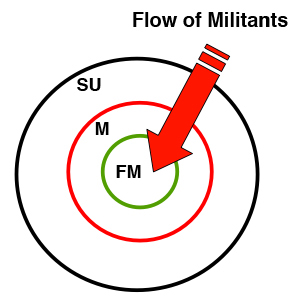
Let us give a practical example: let’s suppose that an organisation has deliberated to work internally with two levels of commitment – or two circles. When the militants are new they enter at the level of “militant” and, when they have been there six months and are prepared and committed militants, move on to the level of “full militant”. Let us suppose that this organisation has resolved to have a level of supporters. The objective of the organisation will be to draw in the greatest possible number of supporters, based on the affinity of each one with the organisation, transferring them to the level of militant and, after six months – once prepared – to the level of full militant. We illustrate how this can work in practice.

Flow of Militants

SU being the level of supporters, M of militants and FM of full militants, the objective is the flow indicated by the red arrow – to go from SU to M and from M to FM. Those who are interested can follow this flow, and those who are not can stay where they feel better. For example, if a person wants to give sporadic support, and no more than that, they may want to always stay at SU. The issue here is that all a person’s will to work should be utilised by the organisation. This is not because a person has little time, or because they prefer to help at a time when it must be rejected, but because inside a specific anarchist organisation there must be room for all those who wish to contribute. “The criteria for selection that never fails are the accomplishments. The aptitude and efficiency of the militants are, fundamentally, measures for the enthusiasm and the application with which they perform their tasks”. [Juan Mechoso. Acción Directa Anarquista. p.199.]

The logic of concentric circles requires that each militant and the organisation itself have very well defined rights and duties for each level of commitment. This is because it is not just for someone to make decisions about something with which they will not comply. A supporter who frequents activities once a month and makes sporadic contributions, for example, cannot decide on rules or activities that must be met or carried out daily, as they would be deciding something much more for the other militants than for themselves.

It is a very common practice in libertarian groups that people who make sporadic contributions decide on issues which end up being committed to or carried out by the more permanent members. It is very easy for a militant who appears from time to time to want to set the political line of the organisation, for example, since it is not they who will have to follow this line most of the time.

These are disproportionate forms of decision-making in which one ends up deciding something which others enact. In the model of concentric circles we seek a system of rights and duties in which everyone makes decisions about that which they could and should be committed to afterwards. In this way it is normal for supporters to decide only on that in which they will be involved. In the same way it is normal for militants of the organisation to decide on that which they will carry out. Thus we make decisions and their commitments proportionally and this implies that the organisation has clear criteria for entry, well defining who does and does not take part in it, and at what level of commitment the militants are.

An important criterion for entry is that all of the militants who enter the organisation must agree with its political line. For this the anarchist organisation must have theoretical material that expresses this line – in less depth for those who are not yet members of the organisation and in more depth for those who are. When someone is interested in the work of the anarchist organisation, showing interest in approximation, you should make this person a supporter and give them the necessary guidance. As a supporter, knowing the political line in a little more depth and having an affinity for the practical work of the organisation, the person may show interest in joining the organisation or the organisation can express its interest in the supporter becoming a militant. In both cases the supporter should receive permanent guidance from the anarchist organisation, giving to them theoretical material that will deepen their political line. One or more militants who know this line well will discuss doubts, debate and make clarifications with them. Having secured the agreement of the supporter with the political line of the organisation, and with agreement from both parties, the militant is integrated into the organisation. It is important that in the initial period every new militant has the guidance of another older one, who will orient and prepare them for work. In any event, the anarchist organisation always has to concern itself with the training and guidance of the supporters and militants so that this may allow them to change their level of commitment, if they so desire.

This same logic of concentric circles works in social work. Through it, the anarchist organisation is articulated to perform social work in the most appropriate and effective way. As we have seen, the anarchist organisation is divided internally into fronts for the performance of practical work. For this there are organisations that prefer to establish direct relations with the social movements, and there are others that prefer to present themselves through an intermediary social organisation, which we could call a grouping of tendency.

Participation in the grouping of tendency implies acceptance of a set of definitions that can be shared by comrades of diverse ideological origins, but which share certain indispensable exclusions (to the reformists, for example) if seeking a minimum level of real operational coherence. (…) The groupings of tendency, co-ordinated with each other and rooted in the most combative of the people (…) are a higher level than the latter [the level of the masses]. [Ibid. pg. 190, 192.]

The grouping of tendency puts itself between the social movements and the specific anarchist organisation, bringing together militants of distinct ideologies that have affinity in relation to certain practical questions.

As we have emphasised, there are anarchist organisations that prefer to present themselves directly in the social movements, without the necessity of the groupings of tendency, and others preferring to present themselves by means of these. In both cases there are positive and negative points and each organisation must determine the best way to act. As the views that we advocate in the social movements are much more practical than theoretical, it may be interesting to work with a grouping of tendency, incorporating people who agree with some or all of the positions that we advocate in the social movements (strength, classism, autonomy, combativeness, direct action, direct democracy and revolutionary perspective) and that will help us to augment the social force in defence of these positions.

In the same way as in the diagram above, the idea is that the specific anarchist organisation seeks insertion in this intermediate level (grouping of tendency) and through it presents itself, conducting its work in social movements in search of social insertion.  Again we illustrate how this works in practice.

 Anarchist influence / Flow of Militants

SAO being the specific anarchist organisation, GT the grouping of tendency and SM the social movement, there are two flows.

The first – that of the influence of the SAO – seeks to go to the GT and from there to the SM. Let us look at a few practical examples. The anarchist organisation that desires to act in a union may form a grouping of tendency with other activists from the union movement who defend some specific banners (revolutionary perspective, direct action, etc.) and by means of this tendency may influence the union movement, or the union in which it acts. Or the anarchist organisation may choose to work with the landless movement and, for this, brings people who defend similar positions (autonomy, direct democracy, etc.) in the social movement together in a grouping of tendency. By means of this grouping of tendency the specific anarchist organisation acts within the landless movement and, in this way, seeks to influence it.

This form of organisation aims to solve a very common problem that we find in activism. For example, when we know very dedicated activists; revolutionaries that advocate self-management, autonomy, grassroots democracy, direct democracy, etc. and with whom we do not act because they are not anarchists. These activists could work with the anarchists in the groupings of tendency and defend their positions in the social movements together.

The second arrow in the diagram shows the objective of the flow of militants. That is, in this scheme of work, the goal is to bring people in the social movements that have practical affinity with the anarchists into the groupings of tendency and, from there, bring those that have ideological affinity closer to the anarchist organisation. In the same way as in the previous diagram, if a militant has great practical affinity with the anarchists, but is not an anarchist, they must be a member of the grouping of tendency and will be fundamental to the achievement of social work. If they have ideological affinities, they may be closer to or even join the organisation.

The objective of the anarchist organisation is not to turn all activists into anarchists, but to learn to work with each of these activists in the most appropriate way. While having mutual interests the militants may change their positions in the circles (from the social movement to the grouping of tendency or from the grouping of tendency to the anarchist organisation). Without these mutual interests, however, each one acts where they think it more pertinent.


Appendix:

Charter of Principles of the Anarchist Federation of Rio de Janeiro
(Federação Anarquista do Rio de Janeiro – FARJ)

 “We desire the freedom and well-being of all men, all without exception. We want that every human being can develop and live in the happiest way possible. And we believe that this freedom and this well-being cannot be given by a man or by a party, but that everyone should find in themselves their conditions, and conquer them.

We consider that only the most complete application of the principle of solidarity can destroy war, oppression and exploitation, and solidarity can only be born of free agreement, of the spontaneous and desired harmonising of all concerned.”

– Errico Malatesta

Anarchism is a political ideology of social transformation,  which is expressed through an anti-authoritarian mode of reflection, interpretation and intervention on reality. It constitutes a revolutionary theory that struggles against all forms of exploitation and oppression. It has its historical origins in the working class struggles over almost two centuries. Committed to these principles, which are a continuation of the organisationalist current of anarchism, the Federação Anarquista do Rio de Janeiro (FARJ) proposes to work – now and without intermediations – in order to interfere in the different realities that make up the universe of social movements.

To achieve its intended goals – to move immediately towards a world where all are free and equal – the FARJ will respect the firm ethical precepts that sustain it, promoting the development of a political culture that is based on respect for the plurality of perspectives and affinity of objectives.

The FARJ is an organisation of active minority, made up of militants conscious of their historical responsibility (“a subject who has a libertarian ethic knows why they’re struggling and is able to explain the ideological motives of struggle, [and] has commitment and self-discipline to carry out the tasks undertaken ” – Ideal Peres). It proposes a radical transformation of society having as its starting point everyday popular life. It seeks always to support the development and strengthening of self-organisation, in the construction of independent and combative activities, in order that we all achieve a truly just society, free and equal, within the conception that each of its components is only an interim fighter inserted in the continued pursuit of human beings but for the realisation of the perfect dream, at least for creating the best possible utopias. To this end, the FARJ always seeks to support the training and development of other self-managed organisations, participating combatively in the day-to-day struggles of popular movements in action, first, in Brazil, in Latin America and especially in Rio de Janeiro.

To achieve these objectives, the FARJ has well-defined principles and content. The assumption of coherence with these principles is what determines ideological authenticity pertaining to anarchism.

In summary, these principles are:

1. Freedom

Freedom is the founding principle of anarchism. The struggle for freedom precedes anarchy. The desire to be free – from the contingencies of nature, principally, and, in the second instance, from human predators themselves, which by means of instruments of domination suffocate true egalitarian and fraternal dynamics –  is the axis around which, in a permanent process historical, social, political and economic transformations turn. Individual freedom, however, can only find its greatest expression in collective freedom. States, capitalism and their results, class society, false educational principles, authoritarian family practices and ideologies of mass alienation, as well as mistaken theories of social emancipation, which lead to the formation of new tyrannies, currently constitute the greatest obstacles to the full libertarian development of humanity.

2. Ethics and Values

The libertarian ethic is synonymous with anarchism, and is its backbone. It is a non-negotiable militant commitment, and presupposes consistency between life and ideology, that is, living anarchism. We understand that the ends are in the means, just as the tree is in the seed, and that we will only arrive at libertarian ends with political responsibility and through libertarian means. Ethics are exercised in mutual respect, and are responsible for defining the priority of values.

3. Federalism

Federalism is a non-hierarchical method of political organisation of society. It presupposes the decentralisation of the process of decision-making and enables the integration of self-managed nuclei at all levels.

It is based on mutual aid and on free association, with equal rights and duties for all. We consider it essential that the federal units exercise their right to deliberate, through delegations taken in the grassroots assemblies, guided by agreed principles, and having the organisational and militant commitment to abide by the resolutions of the council of delegates, thus respecting the decisions of the federative body.

4. Internationalism

Internationalism is exercised, in practice, through federalism. We understand that internationalism is enriched by respect for diversity of cultural practices and is practiced by the solidarity of struggles and through social self-management.

5. Self-management

An anti-capitalist and anti-statist method of socio-economic management at all levels. It is characterised as the management of the means of production and social organisation for the benefit of the collectivity; it is exercised from the grassroots entities, with equal rights and participation of all responsible.

Self-management, as a process of constructing the new, while still living with the current outdated system, potentiates the transformations that point to an egalitarian society.

6. Direct Action

A method of action based on individual and collective protagonism. It is marked by horizontality and by a minimum of intermediation that, when necessary, does not result in the emergence of decision-making centres separated from those concerned.

Direct action is expressed in multiple variants and at all levels and expression, connecting the workers and oppressed to the centre of political action.

 “Only direct action shakes thrones, threatens tyrannies, convolves worlds; it alone, principally, educates and strengthens the dispossessed people in their millennial struggle. Direct action is the revolution.” (José Oiticica)

7. Class struggle

We affirm our identity as workers. We fight for a classless society in which everyone can work and have the right to a dignified life. To achieve this objective, we consciously face a daily class struggle against the exploitative elites and the state. We believe that the end of class society will only be achieved with the emancipation of the oppressed in the process of the social revolution.

8. Political Practice and Social Insertion

We understand that, as workers, our intervention must be guided by our own social reality, based on the struggles that we face in our daily lives. However, considering that we anarchists believe that political action involves a greater commitment to social causes, we must always seek to relate our own militant practice to the diverse manifestations of popular struggles. Therefore, we believe that any expressions in this direction in the social, cultural, peasant, trade union, student, community, ecological etc. camps – as long as inserted in the context of the struggles for freedom – contemplate our political practice of social insertion.

9. Mutual Aid

We propose to achieve active solidarity in struggle, fraternising with all comrades truly working for a more just and egalitarian world. Thus, we consider that mutual aid is a logical and direct consequence of the set of principles of anarchism, since we can only implement them through effective solidarity between the exploited and oppressed.

*     *     *

Our conception is that anarchism, as social thought, does not allow the separating of theory and practice, ends from means and action from transformation; it does not allow for rigid frameworks wishing to establish, for the attitudes of militants, an abstract model that determines their principles and strategies. Anarchism, by being anti-dogmatic and establishing  freedom as its primary concern, seeks in the evident contradictions of the capitalist system its field of action. Therefore, it is within the class struggle that the anarchists must be, while having a society of oppressed and oppressors, of bosses and workers, owners and dispossessed. However, as anarchists understand that the class struggle is a means and not an ends, they must be on the alert for certain interpretations of authoritarian meaning that conceive of history as the mere result of the struggle between classes. If there really is a factor that transforms history for libertarians, it can only be the result of the struggle continually engendered by revolutionaries against oppression and in search of solidarity. For anarchists, man isn’t, in the new society, a simple result of historical materialism. Men are not forged by the hammer blows levelled by predetermined dialectics nor by some scheme that transcends them to concrete action.

Therefore, direct action is not only a means or methodology of combat, but the only way to materialise, in attitudes, the desire for individual and collective transformation. In this way the anarchists, who never sought a scientistic systematisation of their social thought, affirm that only through concrete actions can the radical process of transformation result.

Without masters or dogmas, libertarian militants proceed advocating social insertion in the most pressing issues of their lives. Such a relationship puts in the hands of the people and other organised groups the task of changing everything to please everyone. We think that anarchic elements were present in the classless societies of yesterday, and continue, in those of today, not because they represent the result of economic contradictions, but to express, in the fullest form, the desire for freedom common to all individuals and communities throughout time. For this anarchism served, in the nineteenth and twentieth centuries, as an important inspiration for the struggle against the bourgeoisie in the same way as it should determine the ethical standards of the future anarchic society.

The Workers’ Committee: An Outline of its Principles and Structure (web)

Download PDFby J.T. Murphy

“We will support the officials just so long as they rightly represent the workers, but we will act independently immediately they misrepresent them. Being composed of delegates from every shop and untrammelled by obsolete law or rule, we claim to represent the true feeling of the workers. We can act immediately according to the merits of the case and the desire of the rank and file”.*

One of the most noticeable features in recent trade union history is the conflict between the rank and file of the trade unions and their officials, and it is a feature which, if not remedied, will lead us all into muddle and ultimately disaster. We have not time to spend in abuse, our whole attention must be given to an attempt to understand why our organisations produce men who think in the terms they do, and why the rank and file in the workshops think differently.

A perusal of the history of the labour movement, both industrial and political, will reveal to the critical eye certain tendencies and certain features which, when acted upon by external conditions, will produce the type of persons familiar to us as trade union officials and labour leaders.

Everyone is aware that usually a man gets into office on the strength of revolutionary speeches, which strangely contrast with those of a later date after a period in office. This contrast is usually explained away by a dissertation on the difference between propaganda and administration. That there is a difference between these two functions we readily admit, but that the difference sufficiently explains the change we deny. The social atmosphere in which we move, the common events of everyday life, the people with whom we converse, the struggle to make ends meet, the conditions of labour, all these determine our outlook on life.

Do I feel that the man on the next machine is competing for my job? Do I feel that the vast army who have entered into industry will soon be scrambling with me at the works gates for a job in order to obtain the means of a livelihood? My attitude towards the dilution of labour will obviously be different to the man who is not likely to be subject to such an experience. That is why the Engineers have clashed with the Government officials. They are not likely to be subject to the schemes they have introduced, hence they can talk glibly about safeguards.

Now compare the outlook of the man in the workshop and the man as a full time official. As a man in the workshop he feels every change; the workshop atmosphere is his atmosphere; the conditions under which he labours are primary; his trade union constitution is secondary, and sometimes even more remote. But let the same man get into office. He is removed out of the workshop; he meets a fresh class of people, and breathes a different atmosphere. Those things which were once primary are now secondary. He becomes buried in the constitution, and of necessity looks from a new point of view on those things which he has ceased to feel acutely. Not that he has ceased to feel interested, not that he has become dishonest, not that he has not the interests of labour at heart, but because human nature is what it is, he feels the influence of new factors, and the result is a change of outlook.

Thus we obtain a contrast between those who reflect the working class conditions and those who are remote from them. Consider, now, the effect of this constitutional development. The constitutions invest elected officials with certain powers of decision which involve the members of the organisations in obedience to their rulings. It is true to say that certain questions have been referred to the ballot box ere decisions have been arrived at; but it is unquestionably true, also, that important matters have not been so referred, and increasingly insistent has been the progress towards government by officials. They have the power to rule whether a strike is constitutional or unconstitutional, and accordingly to pay or withhold strike pay. Local business must be referred for executive approval, and, where rules are silent, power to decide according to their judgment is theirs. The latter is probably the most important of all. It allows small groups who are, as we have already shown, remote from actual workshop experience to govern the mass and involve the mass into working under conditions which they have had no opportunity of considering prior to their inception. The need of the hour is a drastic revision of this constitutional procedure which demands that the function of the rank and file shall be simply that of obedience.

This is reflected in all our activities. We expect officials to lead, to shoulder responsibility, to think for us. Hence we get labour leaders, official and unofficial, the one in office, the other out of office, speaking and acting as if the workers were pliable goods, to be moulded and formed according to their desires and judgment. However sincere they may be, and we do not doubt the sincerity of the majority, these methods will not do.

Real democratic practice demands that every member of an organisation shall participate actively in the conduct of the business of the society. We need, therefore, to reverse the present situation, and instead of leaders and officials being in the forefront of our thoughts, the questions of the day which have to be answered should occupy that position. It matters little to us whether leaders be official or unofficial so long as they sway the mass, little thinking is done by the mass.

If one man can sway the crowd in one direction, another man can move them in the opposite direction. We desire the mass of men and women to think for themselves, and until they do this no real progress is made, democracy becomes a farce, and the future of the race becomes a story of race deterioration.

Thought is revolutionary: it breaks down barriers, transforms institutions, and leads onward to a larger life. To be afraid of thought is to be afraid of life, and to become an instrument of darkness and oppression.

The functions of an elected committee, therefore, should he such that instead of arriving at decisions FOR the rank and file they would provide the means whereby full information relative to any question of policy should receive the attention and consideration OF the rank and file, the results to be expressed by ballot. The more responsibility rests upon every member of an organisation the greater is the tendency for thought to be more general, and the more truly will elected officials be able to reflect the thoughts and feelings of the members of the various organisations.

Now we have shown some of the principal defects in the constitutional procedure, we will show how these defects have been and are encouraged by defects in the structure.

The ballot box is no new thing, every trade unionist understands the use of it, yet we find that when there is an election of officers, for example, or a ballot on some particular question, rarely more than forty percent vote; that means there are sixty percent who do not trouble. Being vexed with the sixty percent will not help us. An organisation which only stimulates forty percent to activity must be somewhat defective, and it is our duty to find those defects and remedy them.

A ballot is usually taken in the branches, and the meetings are always summoned meetings, so we will consider now the branch as a unit of the organisation. It is usually composed of members who live in certain areas, irrespective of where they work, and irrespective of the turn on which they work.

These are important factors, and account for a great deal of neglect. Men working together every day become familiar to each other and easily associate, because their interests are common. This makes common expression possible. They may live, however, in various districts, and belong to various branches. Fresh associations have therefore to be formed, which at the best are but temporary, because only revived once a fortnight at the most, and there is thus no direct relationship between the branch group and the workshop group. The particular grievances of any workshop are thus fresh to a majority of the members of a branch. The persons concerned are unfamiliar persons, the jobs unfamiliar jobs, and the workshop remote; hence the members do not feel a personal interest in the branch meetings as they would if that business was directly connected with their every day experience. The consequence is bad attendance at branch meetings and little interest. We are driven, then, to the conclusion that there must be direct connection between the workshop and the branch in order to obtain the maximum concentration on business. The workers in one workshop should therefore be members of one branch.

Immediately we contemplate this phase of our difficulties we are brought against a further condition of affairs which shows a dissipation of energy that can only be described as appalling. We organise for power and yet we find the workers in the workshops divided not only amongst a score of branches but a score of unions, and in a single district scores of unions, and in the whole of the country eleven hundred unions.

Modern methods of production are social in character. We mean by this statement that workers of all kinds associate together, and are necessary to each other to produce goods. The interests of one, therefore, are the interests of another. Mechanics cannot get along without labourers or without crane drivers; none of these can dispense with the blacksmith, the grinder, the forgemen, etc., yet in spite of this inter-dependence, which extends throughout all industry, the organisations of the workers are almost anti-social in character.

They keep the workers divided by organising them on the basis of their differences instead of their common interests. Born at a period when large scale machine production had not arrived, when skill was at a greater premium than it is today, many have maintained the prejudices which organisations naturally cultivate, while during the same period of growth the changes in methods of production were changing their position in relation to other workers, unperceived by them. With the advent of the general labour unions catering for men and women workers, the differences became organised differences, and the adjustment of labour organisations to the changes increasingly complex. The skilled men resent the encroachments of the unskilled, the unskilled often resent what appears to them the domineering tactics of the skilled, and both resent the encroachments of the women workers. An examination of their respective positions will reveal the futility of maintaining these sectional prejudices.

Consider the position of the skilled workers. They have years of tradition behind them, also five years apprenticeship to their particular trade. The serving of an apprenticeship is in itself sufficient to form a strong prejudice for their position in industry. But whilst the skilled unions have maintained the serving of an apprenticeship as a primary condition of membership, industrial methods have been changing until the all-round mechanic, for example, is the exception and not the rule. Specialisation has progressed by leaps and bounds. Automatic machine production has vastly increased. Apprenticeship in thousands of cases is a farce, for even they are kept on repetition work and have become a species of cheap labour. Increasingly are they set to mate men on piece work jobs, and although producing the same amount of work receive only 50 percent of the wages received by the men. It will be thus clearly perceived that every simplification in the methods of production, every improvement to automatic machine production, every application of machinery in place of hand production, means that the way becomes easier for others to enter the trades. So we can safely say that as historical development takes away the monopoly position of skilled workers it paves the way for the advancement of the unskilled.

Working in the same workshops as the skilled men, having to assist them in their work, seeing how the work is becoming simplified, knowing no reason satisfactory to himself why, having had to start life as a labourer, he should decline advancement and remain a labourer, takes time by the forelock, and ere long can compete with the rest on specialised work. So also enter the women workers, and thus ensues a struggle between craft, trade, and sex prejudices.

There are in industry seven millions of women workers, more than a million of whom have entered the engineering industry since the beginning of the war. How far they have been successful is no doubt a surprise to the majority of people. In addition to shell production, which has nearly passed into the hands of women, at least so far as the smaller kinds of them are concerned, we read in the Times Engineering Supplement of June 29th, 1917, an account of women’s work, from which the following is taken:

“In particular the Bristol exhibition was remarkable for the many hundreds of specimens of work wholly or mainly done by women. Apart from the still larger range covered by the photographs, fourteen separate groups of samples were shown, dealing respectively with aircraft engines, motor car engines, magnetos and other accessories of internal combustion engines, locomotive and stationary engines, guns and gun components, small arms, gauges, cutters and allied work, drawing dies and punches, welded and other aircraft fittings, aircraft framing and structural parts, projectiles, miscellaneous engineering, and optical and glass work. The list is long, but its very length summarises no more than fairly the variety of applications that are being made of women’s services in one work or another. A similar variety was seen in the composition of most of the individual groups. Details, for instance, were exhibited of several different aircraft engines, of motor car and motor lorry engines of a variety of makes, of “tank” (land ship) and Diesel engines; of the breech mechanism and other parts of a variety of guns, from the 3-pdr. Hotchkiss to the 8-in. howitzer, and, among small arms, of the Lewis and Vickers machine guns and the Lee-Enfield rifle. Over seventy punches and dies were shown for cartridge-drawing alone, and over a hundred varieties of shell-boring and milling cutters, twist-drills, and allied tools, and nearly as many separate parts of aeroplanes.”

That such production on the part of women is general it would be untrue to say, but it at least shows the tremendous possibilities before the women workers, how far the simplifying process has gone, and how the monopoly position of the skilled worker in all but heavy work has nearly gone. In many workshops, however, it can safely be said that women are not a success. As a matter of fact in some places there has been no attempt to make them a success. They are consequently tolerated with amused contempt as passengers for the war.

This position makes a grievous state of affairs for any post war schemes. It makes possible sham restoration schemes to which we all stand to lose by the magnitude of the unemployed market. Thousands of women may be turned into the streets, or become encumbrances on the men who may be at work or who also may be unemployed. Domestic service cannot absorb all women, as some suggest, nor is it possible, as others remark, for them to go back to what they were doing before the war. To put back the clock of history is impossible, and other solutions will have to be found.

It is true that woman labour is usually cheap labour; it is true that women generally are more servile than men (and they are bad enough); it is also true that they are most difficult to organise because of these defects, thinking less about such matters than men. For these reasons they are more the victims of the employing class. The blame is not altogether theirs. We men and women of today have now to pay the price of man’s economic dominance over women which has existed for centuries. Content to treat women as subjects instead of equals, men are now faced with problems not to their liking.

Yet everyone of the wage earning class, whether man or woman, is in the same fix. Each has to work for wages or starve. Each fears unemployment. The skilled men detest dilution because they fear the lowering of their standard of life by keener competition. The semi-skilled, and the unskilled, and the women each desire to improve their lot. All are in the hands of those who own the means of providing them with work and wages. Skilled men are justified in their desires, and so are the others. The only way the mutual interests of the wage earners can be secured, therefore, is by united effort on the part of all independent workers, whether men or women. Many have been the attempts in the past to bring about this result. Federal schemes have been tried, and amalgamation schemes advocated. Characteristic of them all, however, is the fact that always have they sought for a fusion of officialdom as a means to the fusion of the rank and file.

We propose to reverse this procedure. Already we have shown how we are driven back to the workshops. With the workshops, then, as the new units of organisation, we will now show how, starting with these, we can erect the structure of the Great Industrial Union, invigorate the labour movement with the real democratic spirit, and in the process lose none of the real values won in the historic struggle of the trade union movement.

The Workshop Committee

The procedure to adopt is to form in every workshop a workshop Committee, composed of shop stewards, elected by the workers in the workshops. Skilled, semi-skilled, and unskilled workers should have their shop stewards, and due regard be given also to the particular union to which each worker belongs.

For example:- Suppose a workshop is composed of members of the General Labourers’ Union, Workers’ Union, A.S.E., Steam Engine Makers, Women Workers, etc., each of these unions should have their shop stewards, and the whole co-operate together, and form the workshop committee.

Immediately this will stimulate the campaign for the elimination of the non-unionist. We know of one shop where, as soon as the workshop committee was formed, every union benefited in membership, and one society enrolled sixty members.

Where possible, it is advisable for shop stewards to be officially recognised and to be supplied with rules which lend support and encourage the close co-operation which a workshop committee requires.

We suggest the following as a shop steward’s instruction card, for any of the societies:-

  • Members’ pence cards should be inspected every six weeks.
  • New arrivals into workshops shall be approached by the shop steward nearest to such and questioned as to membership of a trade union.
  • Steward shall demand the production of pence card of alleged member.
  • Steward shall take note of shop conditions, wages, etc., in the area in which he is acting as shop steward, and report any violations of district conditions as approved by the trade unions which are not immediately remedied to the trade union officials.
  • Any dispute arising between employer and employee, which results in a challenge of district conditions as approved, shall be reported to the shop steward.
  • Steward shall then consult with other shop stewards as to the course of procedure to be adopted, the results of such consultation to be submitted to the members in the shop for approval.
  • Matters which affect more than one department shall be dealt with in a similar manner by the stewards in the affected areas.
  • The workers in the workshop should attempt to remedy their grievances in the workshop before calling in official aid.
  • Where members of other unions are affected, their co-operation should be sought.

We would also advise that there be one shop steward to not more than fifteen workers. The more active workers there are the better and easier is the organising work carried on. Also, elect a convener in each shop for each class of worker. Their duties will be to call shop stewards’ meetings in the shop, and be delegates to the district meetings. Other duties we shall mention later.

The initiative should be taken by the workers in the various districts. It is immaterial whether the first move is made through the local trade union committees, or in the workshops and then through the committee, so long as the stewards are elected in the workshops and not in the branches. The means are then assured of an alliance between official and unofficial activities by an official recognition of rank and file control.

Having now described how the workshop committees can be formed, and how the committees can be at the same time part of the official trade union movement, we must now proceed to show how the movement can grow, and how it must grow to meet the demands of the day.

Local Industrial Committees

Local Industrial Committees should be formed in each district. It will be readily perceived that no one firm will be completely organised before the workers in other firms begin to move in the same direction. Therefore in the early stages of development, full shop stewards’ meetings should be held in every district, and an industrial administrative committee be formed from these meetings. The size of the committee will vary according to the size of the district, so we will leave that to the discretion of those who form the committee. The functions of these committees are mainly those of educating and co-ordinating the efforts of the rank and file through the shop stewards. For example, one committee provides information relative to agreed upon district conditions, Munitions Act, Military Service agreement, Labour Advisory Board, procedure in the workshops, etc. Then this committee should be the means of extending and developing the organisations, so that the workers can obtain the maximum of power in their hands.

The committee should not usurp the functions of the local trade union committees, but attend to the larger questions, embracing all the trade unions in the industry.

It will have been observed that we have addressed ourselves, so far as practical procedure is concerned, to the engineering workers. This we have done because the nucleus of the larger organisation has already come into being through that industry, and presents us with a clear line of development. So far, then, we have shown how to form a workshop committee, and an engineering workers’ committee in a locality. These committees should not have any governing power, but should exist to render service to the rank and file, by providing means for them to arrive at decisions and to unite their forces.

Works or Plant Committees

The next step is to intensify the development of the workshop committees by the formation in every plant of a plant committee. To achieve this, all the stewards of each firm, from every department of that firm, should meet and elect a committee from amongst them to centralise the efforts or link up the shop committees in the firm. The need for this development we will endeavour to make clear. Just as it is necessary to co-operate the workshops for production, so it is necessary to co-ordinate the work of the shop committees. As there are questions which affect a single department, so there are questions which affect the plant as a whole. The function of a plant committee, will be such that every question, every activity, can be known throughout the departments at the earliest possible moment, and the maximum of attention be rapidly developed. The complaints of workers that they do not know what is happening would become less frequent. The trick of ‘playing’ one department against another to cut rates could easily be stopped, and so on.

Without a central committee on each plant, the workshop committee tends to looseness in action, which is not an advantage to the workers’ movement. On the other hand with a plant committee at work, every change in workshop practice could be observed, every new department tackled as to the organisation of the workers in that department, and everywhere would proceed a growth of the knowledge among the workers of how intimately related we are to each other, how dependent we are each to the other for the production of society’s requirements. In other words, there would proceed a cultivation of the consciousness of the social character of the methods of production. Without that consciousness, all hope of a united working class is in vain, and complete solidarity impossible.

Instead of it being a theory of a few, that the workers are associated in production, the organisation of the workers at the centres of production will demonstrate it as a fact. Then will the smelters, the moulders, the labourers, forgemen, blacksmiths, etc., and all other workers, emphasise their social relationship, their inter-dependence in production, and the power they can be when linked together on a common basis. Consider this phase of development more closely, and how essential and valuable it is will become increasingly apparent.

Not only do we find in modern capitalism a tendency for nations to become self-contained, but also industrial enterprises within the nations tend in a similar direction. Enterprising employers with capital organised for the exploitation of certain resources, such as coal, iron and steel productions, etc., find themselves at the beginning of their enterprise dependent upon other groups of capitalists for certain facilities for the production of their particular speciality. The result is that each group, seeking more and more to minimise the cost of production, endeavours to obtain first hand control over all which is essential for that business, whatever it may be.

For example, consider the growth of a modern armament firm. It commences its career by specialising in armour plate, and finds itself dependent on outsiders for coal, transport, machinery, and general goods. It grows, employs navvies, bricklayers, joiners, carpenters, and erectors to build new departments. It employs mechanics to do their own repairs to machinery and transport. As new departments come into being a railway system and carting systems follow. Horses, carts, stables, locomotives, wagons, etc., become part of the stock of the firm. What men used to repair they now produce. With the enlargement of the firm electrical plant and motors, and gas producers are introduced, which again enlarge the scope of the management for production of goods for which hitherto they had been dependent upon outsiders. A hold is achieved on some coal mine, a grip is obtained of the railway system, and so at every step more and more workers of every description come under the control of a single employer or a group of employers.

We are brought together by the natural development of industry, and made increasingly indispensable to each other by the simplifying, sub-dividing processes used in production. We have become social groups, dependent upon a common employer or group of employers. The only way to meet the situation is to organise to fight as we are organised to produce. Hence the plant committee to bring together all workers on the plant, to concentrate labour power, to meet centralised capital’s power.

Local Workers’ Committee

We have seen how the formation of workshop committees has led us to the formation of an engineering workers’ committee and the plant committee in a locality. These in turn lead us to further local and national development. There are no clear demarcation lines between one industry and another, just as there are no clear demarcation lines between skilled, semi-skilled, and unskilled workers. A modern engineering plant, as we have shown, has in it workers of various kinds; besides mechanics, moulders, smiths, forgemen, etc., are joiners, carpenters, bricklayers, masons, transport workers, etc., all of which are dependent upon the engineering plant, and must accordingly be represented on the plant committee.

This drives us clear into other industries than engineering and makes imperative a similar development in these other industries as in the engineering industry. Then, just as from the trade union branches we have the trade council, so from the various industrial committees representatives should be elected to form the local workers’ committee.

It will be similar in form to a trades council, with this essential difference—the trades council is only indirectly related to the workshops, whereas the workers’ committee is directly related. The former has no power; the latter has the driving power of the directly connected workers in the workshops. So the workers’ committee will be the means of focussing the attention of the workers in a locality upon those questions which affect the workers as a whole in that locality.

The possibilities of such an organisation in a district are tremendous. Each committee will be limited by its nature to certain particular activities: the workshop committee to questions which affect the workshop, the plant committee to questions affecting the firm as a whole, the industrial committee to the questions of the industry, the workers’ committee to the questions relating to the workers as a class. Thus we are presented with a means of intensive and extensive development of greater power than as workers we have ever possessed before.

We have already shown in our remarks on the plant committee how industry progresses inside an engineering plant, and implies a similar development in other industries. One has only to consider modern machine development to readily realise that as machinery enters the domain of all industries, as transport becomes more easy and mechanical, all kinds of workers become inter-mingled and inter-dependent. Engineering spreads itself out into all classes of industry—into the mining industry, the building industry, into agriculture, etc., until we find, just as the other industrial workers have mingled with other engineering workers, so engineering workers and others intermingle with other industrial workers in their respective industries. The consequences are such that fewer situations arise, fewer questions come to the front affecting one industry alone or one section alone, and it becomes increasingly imperative that the workers should modify or adjust their organisations to meet the new industrial problems; for no dispute can now arise which does not directly affect more than the workers in one industry, even outside a single plant or firm.

A stoppage of much magnitude affects the miners by modifying the coal consumption, affects the railways by holding up goods for transport, and in some cases the railway workers are called upon, to convey “blackleg” goods and men to other centres than the dispute centres, and vice versa. A stoppage of miners soon stagnates other industries, and likewise a stoppage of railway workers affects miners, engineers, and so on. The necessity for mutual assistance thus becomes immediately apparent when a dispute arises, and an effective co-ordination of all wage workers is urged upon us. The workers’ committee is the means to that end, not only for fighting purposes, but also for the cultivation of that class consciousness, which, we repeat, is so necessary to working class progress. Furthermore, as a means for the dissemination of information in every direction, such a committee will prove invaluable, and reversing the procedure, it will be able to focus the opinions of the rank and file on questions relating to the working class as no other organisation has the facilities to do today.

To encourage and to establish such an organisation, however, demands cash to meet the expenses involved. In order therefore that even in this matter the class basis shall be recognised, we recommend that associate membership cards be issued from the workers’ committee. The card should contain a brief statement of the objects we have in view, and space for the entrance of contribution, which should be nominal in amount. The manner of collecting contributions can be easily carried out, as follows: let the contribution be paid to the shop steward, who will enter the amount on the card provided, the stewards will then pay over to the convenor of the shop, who will in turn, pay over the amount to the treasurer of the workers’ committee at the shop stewards’ meeting, each checking the payments of the other.

National Industrial Committees

The further extensive development in the formation, of a national industrial committee now demands our attention, for it will be readily agreed that the local organisations must be co-ordinated for effective action.

We are of the opinion that the local structure must have its counterpart in the national structure, so we must proceed to show how a national industrial committee can be formed. In the initial stages of the movement it will be apparent that a ballot for the election of the first national committee would be impossible, and as we, as workers, are not investing these committees with executive power there is little to worry about. Therefore a national conference of delegates from the local industrial committees should be convened in the most convenient centre. From this conference should be elected a national administrative committee for that industry, consideration being given to the localities from which the members of the committee are elected. Having thus provided for emergencies by such initial co-ordination the first task of the committee is to proceed to the perfecting of the organisation.

It will be essential for efficiency to group a number of centres together for the purpose of representation on the national administrative committee of the industry. We would suggest twelve geographical divisions, with two delegates from each division, the boundaries of the division depending upon the geographical distribution of the industry. The functions of the committee should be confined to the focussing of questions of a national character relating to the industry. It must be clearly understood that the national industrial committee is not to usurp the functions of the executive councils of the trade unions. Power to decide action is vested in the workshop so far as these committees are concerned.

If the occasion arises when the rank and file are so out of touch with the executive councils of their unions that they take action in spite of them, undoubtedly they would use whatever organisation lay to hand. Apart from such abnormal circumstances the functions of the committee should be confined to the building up of the organisation, to the dissemination of information throughout the workshops of all matters relating to the industry, initiating ways and means of altering the structure and constitutions of the trade unions, and working with the true spirit of democracy until the old organisations are so transformed that the outworn and the obsolete are thrown off, and we merge into the larger, more powerful structure we have outlined.

National Workers’ Committee

But just as we found it necessary to arrive at the class basis in the local workers’ committee, so it is essential that we should have the counterpart to it to the national workers’ committee. Again we find that history justifies the development. As the trade unionists of the past felt that there was a community of interest between all trade unionists in a locality, and formed the trades council, so they eventually found a similar move on national lines necessary and formed the trades union congress. Its counterpart in our movement is the national workers’ committee. To form this we suggest two delegates should be elected from each national industrial committee. The smallness of the committee will not be a disadvantage. Of its nature it will confine itself to questions which affect the workers as a whole. The financial relationship of the industrial committees and the national workers’ committee can be arranged at the conferences when the initial steps are made to the formation of the committees.

Having outlined the manner in which the structure can grow out of the existing conditions, we would emphasise the fact that we are not antagonistic to the trade union movement. We are not out to smash but to grow, to utilise every available means whereby we can achieve a more efficient organisation of the workers, that we all may become conscious by an increasing activity on our part how necessary each worker is to the other for production and for emancipation.

Unity in the workshop must come first; hence we have dealt more in detail with the shop committees than the larger organisations growing out of them. Not for a moment would we lay down a hard and fast policy. The old mingles with the new. Crises will arise which will produce organisations coloured by the nature of the questions at issue. But apart from abnormal situations we have endeavoured to show a clear line of development from the old to the new.

Working in the existing organisations, investing the rank and file with responsibility at every stage and in every crisis; seeking to alter the constitution of every organisation from within to meet the demands of the age; working always from the bottom upwards—we can see the rank and file of the workshops through the workshop committees dealing with the questions of the workshops, the rank and file of the firms tackling the questions of the plant as a whole through the plant committee, the industrial questions through the industrial committees, the working class questions through the working class organisation—the workers’ committee. The more such activity grows the more will the old organisations be modified, until, whether by easy stages or by a general move at a given time, we can fuse our forces into the structure which will have already grown.

So to work with a will from within your organisations, shouldering responsibility, liberating ideas, discarding prejudices, extending your organisations in every direction until we merge into the great industrial union of the working class. Every circumstance of the age demands such a culmination. The march of science, the concentration of the forces of capitalism, the power of the State, the transformation of the military armies into vast military industrial armies, all are factors in the struggles of the future, stupendous and appalling to contemplate. During the greatest war in history—an engineers’ war—the British Government can allow 80,000 to 90,000 engineers to cease work for three weeks. Let the war cease, liberate the vast number of industrial workers from the army, and what becomes of our petty strike? It sinks into insignificance.

“His Majesty’s Government will place the whole civil and military forces of the Crown at the disposal of the railway companies…” So said the Premier of 1911 to the railway men. So will say the Premier of England tomorrow. The one mighty hope, the only hope, lies in the direction indicated, in a virile, thinking, courageous working class organised as a class to fight and win.


* Hinton, ‘The Clyde Workers Committee and the dilution struggle’ in Briggs & Saville, Essays in Labour History, Vol. II, 1971


Text from the LibCom site with corrections made in reference to the hard copy
edition published by Class War Classix

www.libcom.org     –     Class War Classix

Marx’s Economics for Anarchists: An Anarchist’s Introduction to Marx’s Critique of Political Economy (web)

Download PDFby Wayne Price

“The transcripts of the 2006 meetings [of the governors of the Federal Reserve Board and the presidents of the 19 regional banks]… clearly show some of the nation’s pre-eminent economic minds did not fully understand the basic mechanics of the economy that they were charged with sheparding. The problem was not a lack of information; it was a lack of comprehension, born in part of their deep confidence in economic forecasting models that turned out to be broken.”

NY Times (January 13, 2012); p. A3.


Chapter 1: Introduction

Chapter 2: The Labour Theory of Value

Chapter 3: Cycles, Recessions, and the Falling Rate of Profit

Chapter 4: Primitive Accumulation at the Origins of Capitalism

Chapter 5: The Epoch of Capitalist Decline

Chapter 6: The Post-War Boom and Fictitious Capital

Chapter 7: State Capitalism

Chapter 8: Socialism or Barbarism?

Chapter 9: What Marx Meant by Socialism/Communism

Chapter 10: An Anarchist Critique of Marx’s Political Economy

Continue reading

Witches, Midwives and Nurses: A History of Women Healers (web)

Download PDFby Barbara Ehrenreich and Deirdre English

An early 1970s left feminist interpretation of Malleus Maleficarum * is the centrepiece of this essay by Barbara Ehrenreich and Deidre English. Witches, Midwives and Nurses explains how the American medical profession came to be dominated by rich, white men. It sets the tone for a dark story of the co-optation by men of medicine as practiced by women from the earliest times and the subsequent alienation, persecution, and subjugation of such women with the rise of the male-dominated “medical profession.” The tragic irony of this tale is that all the good about that profession came from the independent “wise women” of olde.

Originally published by The Feminist Press at CUNY.

 “To know our history is to begin to see how
to take up the struggle again!”


Introduction

Women have always been healers. They were the unlicensed doctors and anatomists of western history. They were abortionists, nurses and counsellors. They were pharmacists, cultivating healing herbs and exchanging the secrets of their uses. They were midwives, travelling from home to home and village to village. For centuries women were doctors without degrees, barred from books and lectures, learning from each other, and passing on experience from neighbour to neighbour and mother to daughter. They were called “wise women” by the people, witches or charlatans by the authorities. Medicine is part of our heritage as women, our history, our birthright.

Today, however, health care is the property of male professionals. Ninety-three percent of the doctors in the US are men; and almost all the top directors and administrators of health institutions. Women are still in the overall majority — 70 percent of health workers are women — but we have been incorporated as workers into an industry where the bosses are men. We are no longer independent practitioners, known by our own names, for our own work. We are, for the most part, institutional fixtures, filling faceless job slots: clerk, dietary aide, technician, maid.

Continue reading

An Anarchist Society (web)

Download PDFby Pyotr Kropotkin

An Anarchist Conception of Society

[A] variety of considerations, historical, ethnological, and economic, have brought the Anarchists to conceive a society very different from what is considered as its ideal by the authoritarian political parties. The Anarchists conceive a society in which all the mutual relations of its members are regulated, not by laws, not by authorities, whether self-imposed or elected, but by mutual agreements between the members of that society and by a sum of social customs and habits — not petrified by law, routine, or superstition, but continually developing and continually readjusted, in accordance with the ever-growing requirements of a free life, stimulated by the progress of science, invention, and the steady growth of higher ideals.

No ruling authorities, then. No government of man by man; no crystallisation and immobility, but a continual evolution — such as we see in Nature. Free play for the individual, for the full development of his individual gifts — for his individualisation. In other words, no actions are imposed upon the individual by a fear of punishment; none is required from him by society, but those which receive his free acceptance. In a society of equals this would be quite sufficient for preventing those unsociable actions that might be harmful to other individuals and to society itself, and for favouring the steady moral growth of that society…

Continue reading

Anarchism, Racism and the Class Struggle (web)

Download PDFby the ex-Workers’ Solidarity Federation of South Africa.

Racial oppression remains a defining feature of the modern capitalist world. It is manifest most spectacularly in violent attacks on immigrants and minorities by fascist gangs. More important to the fate of these communities has been the systematic and increasing discrimination by capitalist states, manifest in attacks on the rights of immigrants, cuts in welfare services, and racist police and court systems.

Continue reading

Against the Racist Delirium (web)

Download PDFCamillo Berneri

The Racist Delirium

Fascism, the triumph of the irrational, has taken the most discredited myths of pre-scientific ethnology to its bosom. One of the theorists of Hitlerism (assuming that it can be regarded as a body of doctrine), Ernest Krieck, in his book National Political Education (page 17), proclaims the need to subject science to National Socialist politics, thereby giving science the kiss of death.

“The age of ‘pure reason’, of ‘science for the sake of science’, of ‘disinterested science’, is over. Any science that has an active contribution to make towards a broad objective becomes political, and thus, like politics, has its principles and its accomplishments alike, imbued with racism, nationalism and National Socialism.”

Continue reading

The World Crisis and an Anarchist Response (web)

Download PDFby Wayne Price

Contents:

  • What Next?
  • The Crisis
  • Reactions to the Crisis: Liberalism and Reformist Socialism
  • Reactions to the Crisis: Fascism
  • Reactions to the Crisis: The Far Left

What Next?

Facing an economic crisis of world historical proportions, the worst since the Great Depression, the United States has already responded with striking political changes, particularly the election of the first African-American president. What is likely to happen in the future and what should be the response of revolutionary class-struggle anarchists?

The Crisis

Economically, what has begun is either a deep, lengthy, world-wide, recession — or a collapse into a second Great Depression, possibly worse than the first.

Continue reading

Technology, Capitalism and Anarchism (web)

Download PDFby Anarcho

Technology has an obvious effect on individual freedom, in some ways increasing it, in others restricting it. However, since capitalism is a social system based on inequalities of power, it is a truism that technology will reflect those inequalities, as it does not develop in a social vacuum.

No technology evolves and spreads unless there are people who benefit from it and have sufficient means to disseminate it. In a capitalist society, technologies useful to the rich and powerful are generally the ones that spread. This can be seen from capitalist industry, where technology has been implemented specifically to deskill the worker, so replacing the skilled, valued craftsperson with the easily trained (and eliminated!) “mass worker.” By trying to make any individual worker dispensable, the capitalist hopes to deprive workers of a means of controlling the relation between their effort on the job and the pay they receive. In Proudhon’s words, the “machine, or the workshop, after having degraded the labourer by giving him a master, completes his degeneracy by reducing him from the rank of artisan to that of common workman.” [1]

Continue reading

Bakunin vs. the Primitivists (web)

Download PDFby Brian Oliver Sheppard

This article is a critique of so-called “primitivism,” an anti-technological current mainly based in Western countries. It has a degree of influence amongst a sector of anarchists, but the author is incorrect to use the term “anarcho-primitivist,” as this suggests “primitivism” is a form of anarchism. It is not. As the author himself notes, Bakunin’s ideas are the key reference point for anarchism, and radically at odds with “primitivism”. That said, the criticisms posed are useful, and so, I thought this paper worth recovering from obscurity.

Lucien van der Walt


In Bakunin’s day, those who longed for pre-capitalist, feudal social relations were the aristocracy. Those who took it even further and hearkened back to the days before feudalism, before slavery and to the days of free nomadic peoples, were the romanticists. They were inspired in the main by the political writings of Jean-Jacques Rousseau and by much romantic poetry and literature that indicted industrial civilization. They regarded intuition at least as important as rational deliberation, but usually more so.

The values held by these romantic socialists are very similar to those held by anarcho-primitivists [sic.]. Bakunin often spoke against the romanticist socialists; he felt they held individualist values that could only develop in a very privileged milieu and which reflected that privilege and its latent elitism. What Bakunin condemned in the thinking of the political followers of Rousseau are largely the same things found in modern primitivism. It is this commonality between the political romanticism of the Rousseauists and the beliefs of modern anarcho-primitivists that makes Bakunin’s statements applicable to the present state of the anarchist movement, especially to the anti-worker, primitivist element within it.

“In every Congress of the International Workingmen’s Association,” Bakunin lamented in the late 1860’s, “we have fought the individualists or false-brother socialists who say that society was founded by a free contract of originally free men and who claim, along with the moralists and bourgeois economists, that man can be free, that he can be a man, outside of society.” Bakunin’s refers here to the followers of Jean-Jacques Rousseau, and his criticism carries weight to this day. In the anarchist movement, the romantic, anti-society sect are the primitivists.

“Me against the World”

A tendency in the contemporary American radical movement is for individuals, particularly newly emerging radicals, to see themselves as enlightened, impassioned rebels struggling against a morass of public ineptitude. In the highly individualistic West, such a conception of the world and one’s relation to it is hard to avoid, given how individuals are socialized to think of themselves as the height of importance – as with others on the mere periphery. This can be true even of those who bear the brunt of class, gender, and/or racial oppression in Western societies. Some radicals never move beyond this phase, and they see the chief struggle as an individual one against the rest of humanity.

Everyone is an ignoramus, the script seems to go for these enlightened rebels, and I, who can see through the haze that has so deluded others, am unfortunately caught in the midst of a society of oppressors and of complicit idiots that I am condemned to struggle against by virtue of my gifts, gifts of perception that allow me to see things as they really are but which also burden me with a life of hardship (due to “society”). This feeling of alienation is no doubt common, but when it manifests in a belief in primitivism, that coercion is part and parcel of technological advance, then primitivists are led to advocate, as has been done in the anarchist ‘zine Killing King Abacus, that what is needed is a “revolutionary project that can destroy this society and its institutions.” (“Against the Logic of Submission: Revolt, Not Therapy,” ‘Wilful Disobedience,’ Vol. 2, No. 10)

With the “me versus the world” motif solidly in place, the young rebel proclaims society itself as the oppressor, adding that true freedom can only be possible outside society’s clutches, and never within it or though it.

Rousseau’s romanticism feeds into this egocentric conception of the world perfectly, and it is why Bakunin and other anarchists saw individualist romanticism as a dangerous trend in the anti-capitalist, anti-statist movement. The statement of Rousseauists that “a man can be free, that he can be a man, [only] outside of society,” is implicitly elitist. It is a misanthropic view. It sees social interaction (in the large sense) as something bad, as something to be avoided, since associating with a group – a society – must always lead to oppression. One is always served best by avoiding associations of others, as such associations can only oppress or make one conform in an undesirably herdlike manner.

Rousseau’s idea of the social contract posited that at one prehistoric point in time, people lived as atomized, isolated individuals who one day decided to come together for mutual protection and benefit. Living together necessitated loss of liberty; this trade-off between complete freedom and social obligation was the “social contract.” It meant that so long as humans decided to live in societies, they were necessarily not free. True freedom was possible only in isolation, away from society.

The Theory of the Free Contract is false

 “It was a great fallacy on the part of Jean-Jacques Rousseau to have assumed that primitive society was established by a free contract entered into by savages,” Bakunin responds in “The Immorality of the State.” In Three Lectures to Swiss Members, he continues, stating, “In the past there has never been a free contract. There has only been brutality, stupidity, injustice, and violence … The theory of the free contract is just as false from the standpoint of nature. Man does not voluntarily create society; he is involuntarily born into it. He is above all a social animal. Only in society can he become a human being, that is, a thinking, speaking, loving, and wilful animal.”

Modern society is bad, anarchists agree; but it is bad because its modern form is bad, not because society is absolutely bad, no matter its structure. “The State is a transitory historic form, a passing form of society,” Bakunin wrote, “like the Church, of which it is a younger brother.”

Society is not inherently oppressive, though it can assume forms that are. To the followers of Rousseau, however, society itself is the problem, and real freedom can only be maintained outside its purlieus. Humans are inherently oppressive when relating in groups, according to this belief, since association means renunciation of liberty. This belief in the inherent tendency towards coercion when humans relate in groups can be seen as a liberal version of the belief taught by organised religion that people are inherently sinful and will always do ill.

The duty of the person who seeks true freedom is to waste no time with others, but rather to seek out his own individual course, and to expect resistance by the rest of the herd, who will tend to repress when associated with, or so the Rousseauist idea leads one to deduce. The duty of the freedom-seeker, from the liberal Rousseauist point of view, is to declare war on society itself, or somehow boycott it.

A Revolt against the idea of Society is impossible

Bakunin answers this well: “A radical revolt against society would be … just as impossible for man as a revolt against Nature, human society being nothing else but the last great manifestation or creation of Nature upon this earth. And an individual who would want to rebel against society, that is, against Nature in general and his own nature in particular, would place himself beyond the pale of real existence, would plunge into nothingness, into an absolute void, into lifeless abstraction, into God.”

By placing themselves “beyond the pale of real existence” and becoming, as Bakunin notes, modern imitators of Narcissus, egotistical individualists resemble more, in their arrogance, the powerful elites who control and dominate society than revolutionaries. Indeed, the problem with the corporate elites and politicians who control our affairs today is that they, too, place themselves beyond the pale of society, and assume God-like positions of power in which their decision making abilities have unchecked ramifications upon the lives of humans across the globe and upon the global environment as well. Such people follow the liberal Rousseauist attitude that society – collections of humans – are inherently oppressive, thus rendering their control necessary. Control of people’s supposed innate viciousness has always been given as the rationalization for the existence of the State.

To primitivists, true freedom is tantamount to finding a place where one can dwell beyond the burden of social responsibility. Corporate elites and the wealthy have found that place, and demonstrate it by continually acting in their own interests rather than society’s. But for liberal bourgeois radicals who see even this, quite despite themselves, as a part of the oppression by “society,” the only solution is to travel off somewhere away from everyone, to live alone, away from all of humanity’s evil, in an environment of what they believe to be pure and total freedom. In this setting, it is assumed that all of one’s powers may finally flower, leading to true self-actualization. Rural communes, retreats and other lifestylist forays are evidence that people do, in fact, attempt to drop out and leave society behind.

Escapism is not Revolutionary

“Imagine a man endowed with the most inspired powers by nature,” Bakunin writes, “cast out from all human society into a desert since infancy. If he does not miserably perish, which is the most probable result, he will become nothing but a boor, an ape, lacking speech and thought … Even if you are alone with yourself, perfectly isolated, you must use words to think. To be sure, you can have conceptions which represent things, but as soon as you want to consider something you must use words, for words alone determine thought, giving the character of thought to fleeting representations and instincts. Thought hardly exists before speech, nor does speech exist before thought. These two forms of the same activity of the human brain are born together. Thought is therefore impossible without speech. But what is speech? It is communication. It is the conversation of one human individual with many other human individuals. Only through this conversation and in it can a nimalistic man transform himself into a human being, that is, a thinking being. His individuality as a man, his freedom, is thus the product of a collectivity.”

Speech is indeed evidence of the social nature of man. That solitary confinement is such a cruel punishment shows that in some deep sense humans need contact with one another. Before solitary confinement, it was not uncommon to expel “undesirable” individuals from the group, to cast them into exile. Isolation has often served as a punishment; that it worked shows that its consequences are undesirable for most people. It has rarely given them ample opportunity to freely develop or become self-actualized human beings. (Any “isolation” such as religious monasticism or writers’ retreats is an “isolation” doubtless predicated upon pre-existing, beneficial social relations; i.e. monks relate with one another and use facilities built by others, writers use paper and writing materials made by others, to give some possible examples).

It is hard, in this case, to see how a disdain for – or rebellion against – the idea of society itself could represent a striving for true freedom, when being deprived of social relations has historically amounted to a punishment. The possibilities for freedom that exist through social interaction are far richer than those that exist in isolation.

The social anarchist position is that only certain constellations of social relations are oppressive and undesirable, and that there is potential for a liberatory society. In effect, the primitivists condemn all human relations. Primitivists may not agree with this characterization, just as, for example, capitalists might not agree that the system they support wreaks havoc on the environment or on peoples’ lives. Despite what is outwardly claimed, a look at the underpinnings of primitivist ideas reveals that the ideology is predicated upon a set of beliefs inconsistent with any goals of increasing human freedom, happiness or equality.

Far from believing that all possible constellations of human social relations are destructive, social anarchists believe that there exist relations that can increase freedom and help humans develop to their fullest potential. The solution is not to leave all of society, part and parcel, and live away from civilization as a hermit. Nor is it to damn the abstraction of “consumer/ industrial/ modern society” and advocate that “society and its institutions be destroyed” as many passionate young primitivist rebels do. The solution is to work for revolutionary social change so that society may hold true to its promise of helping fully develop humanity’s latent potentialities.

The Noble Savage as Primitivist Ideal

Rousseau’s “noble savage,” a distinctly Anglo/Eurocentric creation that has assumed the status of archetype in the imperialist West, was the model of the truly free, natural man. The noble savage is noble for living in organic unity with the environment, a conscious choice made to preserve freedom, seeing that what is called “civilization” is really an estrangement from the primal, feral self.

The “noble savage” is today reflected in much of the New Age fad, through images of indigenous peoples couched in mystic symbolism, living psychically wholesome, adventurous and unrestricted lives in a state of nature. “Southwestern art,” New Age paraphernalia, and occult shops display this tendency clearly. A colonized people is held up to privileged, imperial citizens as symbols of a simpler, less restrictive past, representing a sort of Edenic existence for the bourgeois. Many express a yearning for this through meditation, sweat lodge excursions, or classes on forgotten, ancient ways of “wiser” peoples.

Such people live in “natural liberty,” as Rousseau called it – or, at least, closer to it than inhabitants of modern civilization. Such people lead more wholesome lives, attuned to the rhythms of an ancient existence. “Once the social compact is violated,” Rousseau explains in On the Social Contract, “each person then regains his first rights and resumes his natural liberty, while losing the conventional liberty for which he renounced it.”

The “natural liberty” regained is the anti-social liberty of renouncing social ties. It is the liberty of the primitivist rebel who looks backward, to the past of human history, for liberation, rather than forward.

“This theory revealed by J-J. Rousseau,” Bakunin writes, “the most malevolent writer of the past century, the sophist who inspired all the bourgeois revolutionaries, betokens a complete ignorance of both nature and history. It is not in the past, nor even in the present, that we should seek the freedom of the masses. It is in the future.”

Bakunin could do just as well to say this to our primitivists today – for they, as the modern adherents of the bourgeois, romanticist tradition of Rousseau, whether conscious or not, look to the past for freedom. Social anarchists, however, look to a future that is as of yet unformed and there for the taking for whoever wants it. Such a claim to the future must be realized through collective effort, however; no individual can rebel against “society” and have the future. Dumping technology and civilization is no realistic option. In a letter that Voltaire sent to Rousseau after reading his essay on the noble savage, Voltaire claimed, “One longs, in reading your book, to walk on all fours.”

How might Voltaire respond to an essay by John Zerzan, or Feral Faun, or any other of our primitivist writers, who extol ancient people and their ways as holding the key to our liberation? How might he respond to such primitivist heroes as Ted Kaczynski, who shunned society to live a remote, primitive lifestyle where he could supposedly be truly free?

“The freedom of individuals is by no means an individual matter,” Bakunin claimed in defiance of this bourgeois individualist tradition. “It is a collective matter, a collective product. No individual can be free outside of human society or without its cooperation … Everything human in man is the product of a collective, social labor. To be free in absolute isolation is an absurdity invented by theologians and metaphysicians who have replaced the society of humans by that of God, their phantom. They say that each person feels free in the presence of God, that is, in the presence of absolute emptiness, Nothingness. Freedom in isolation, then, is the Freedom of Nothingness, or indeed the Nothingness of freedom: slavery.”

These ideas on society and its desirability were not Bakunin’s alone, but form the bulk of much traditional anarchist thinking. Accepting or rejecting ideas based on their own soundness and not on the stature of the person uttering them is of course key if we are to avoid clothing some individuals in the raiment’s of sainthood, regarding all they speak as Holy Writ. However, Kropotkin, Rocker, Malatesta, Berkman, etc., all claimed that what was in order for revolutionaries was not the destruction of “society” as such, but rather the destruction of the modern form of society, to be replaced with a newer form – one that built upon the technological advances of capitalist society but jettisoned its oppressive social forms otherwise. If one disregards the basic social insights of these thinkers – as one would have to were one to believe primitivist ideas – then in what sense is one working within the milieu of Bakunin, Kropotkin, et. al. – namely, the milieu of anarchism? If a group doesn’t work within the anarchist milieu, then why should they receive such massive coverage and publication in anarchist journals? Why not give equal time to Trotskyists or others who likewise aren’t working within an anarchist milieu?

Bakunin isn’t God, and just because he says something, it isn’t necessarily true (and there are other things about which Bakunin was quite wrong). But that much of Bakunin’s analysis forms the basis of subsequent antiauthoritarian thought up until our own time is a virtual truism. If the anarchist movement is ready to reject the insights that Bakunin gave us about society, then primitivism can perhaps be accepted as an adequate successor. But if Bakunin’s insights are going to be regarded as still relevant, as insights anarchists still consider true and worthy, then they are in bitter conflict with the ideas of primitivism. If we are going to be consistent, we can hold one set of beliefs – but not both of them.


Brian Oliver Sheppard is an anarchist writer and organiser who writes for The Industrial Worker and has written for Anarcho-Syndicalist Review, Kontrapunkt, Barricada, and other anarchist papers. His Exploitation and How it Affects You was published by Barricade Books in Melbourne, Australia, in 2000. He can be reached at bsheppard@bari.iww.org

First published in “Onward: Anarchist News, Opinion, Theory, and Strategy of Today” newspaper, in 2000. The “Onward” site is done, but the URL was www.onwardnewspaper.org/