![[Poster] If you’re unemployed it’s not because there isn’t any work](https://zabalazabooks.net/wp-content/uploads/2017/04/poster-if-you-are-unemployed.gif?w=676)
Click above picture to download A4 poster
Click above picture to download A4 poster

Click above picture to download A4 poster
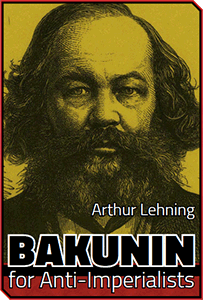 Author: Arthur Lehning | File size: 392 KB
On imperialism itself, [Mikhail] Bakunin [1814-1876] has nothing specifically to say. That is not strange, because imperialism in its modern form had not yet appeared; besides, opposition to imperialism by a revolutionary is a rather obvious thing. But I think Bakunin’s writings can be useful to anti-imperialists in several ways. Firstly, on account of the general view held by Bakunin about the essence of the revolutionary struggle and his conceptions about federalism and the state. Secondly on account of his activities in the eighty forties.
As far as the last point is concerned, it is clear that I don’t wish to stress it too much. All historical parallels can be abusive. However, it is not abusive to point out the similarities between various kinds of Nineteenth Century nationalism and anti-imperialism in our time. This is not only because a great deal of today’s anti-imperialist fight is carried out on nationalist platforms, but also on account of the intensity with which the banner of then and that of today monopolise the attention of men with radical consciousness. In this respect, Bakunin has important things to say….
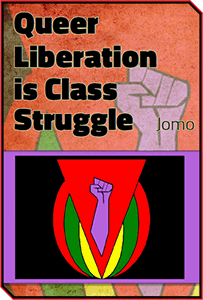 Author: Jomo | File size: 388 KB
In the past two years, the issue of gay marriage has dominated the scene of queer struggles. Some of us are actively supportive, others, grudgingly supportive, and more others who rail that yet again, queer struggles are being monopolized by assimilationist, middle class versions of normality and family: “We are the same as you, except for in bed.”
Some supporters of gay marriage point to the economic benefits of marriage. Working class and poor queers need marriage to help alleviate their poverty; immigrant queers need marriage to get US citizenship. I agree. Yet, let’s not forget that many queers will never get married because of their suspicions of state institutions. Granting gay marriage doesn’t guarantee that immigrant spouses get visas or are free from ICE harassment. Also, around us we see families for whom marriage has not helped alleviate the race and class oppressions that they face everyday….
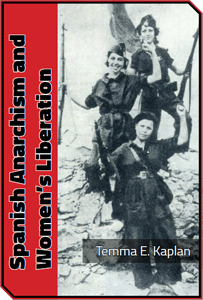 Author: Temma E. Kaplan | File size: 291 KB
One of the chief ideological disputes between the Spanish anarchists and communists during the Civil War was the anarchists’ insistence that social revolution should not be postponed until the war was won; without the social revolution (by which they meant the defeat of authoritarianism and the transformation of all social and economic relations and institutions to permit maximum individual freedom, self-expression, and spontaneity), the war would be just another changing of the guard, so familiar in Spanish history.
![[Leaflet] Thinking about Anarchism: What is Anarchism? - John Flood](https://zabalazabooks.net/wp-content/uploads/2016/01/leaflet-thinking-about-anarchism-what-is-anarchism-j-flood.gif?w=676) Author: John Flood | File size: 111 KB
Author: John Flood | File size: 111 KB
Many people still associate anarchism with violence, destruction, and chaos. This concept of anarchism is reinforced by the corporate media, and those that have an interest in discrediting the anarchist movement. Needless to say this idea of anarchism bears no correlation with the society we are trying to create, or our struggle to achieve it.
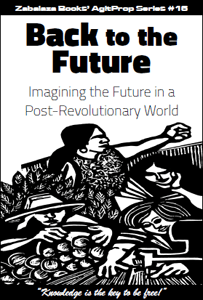 Author: Unknown | File size: 356 KB
Much of our time as revolutionaries is spent on the routine of organising in the here and now – building a campaign, organising for a demonstration, planning for a trade union meeting…. Too often we don’t manage to take time to step back from the here and now and imagine or envisage what it’s all about. But without dreaming, without imagining a future the daily humdrum can seem dispiriting.
To really build for a new society, we need to try to paint a picture of what that society might look like. And we need to be able to suspend reality and dream of the sort of future that might be out there. This article is the first of what we hope will be a series which will attempt to look into a post-revolutionary future and imagine what such a society might look like.
Read and dream….
 Author: Dónal O’Driscoll | File size: 298 KB
Privilege and the theory around it is a significant topic of debate at the moment among those interested in radical social change. Touching on many issues dear to the hearts of anarchists, it is hard to avoid. Yet, the two are not fitting together as well as they should and there is a sense of unease about this. Much of this is because privilege theory has emerged from US academic circles rather than anarchist ones and, ironically, has been co-opted to protect middle- class privileges. This is a situation in need of repair if we are to maintain our links with feminist, anti- racist and other struggles against oppression. If we are to create a mass movement capable of social change then it has to be able to engage with everyone in the first place.
![[Leaflet] Thinking about Anarchism: Anarcha-Feminism - Deirdre Hogan](https://zabalazabooks.net/wp-content/uploads/2016/01/leaflet-anarcha-feminism-deirdre-hogan.gif?w=676) Author: Deirdre Hogan | File size: 158 KB
Author: Deirdre Hogan | File size: 158 KB
An important principle of anarchism and one that more than any other differentiates it from other types of socialism is its emphasis on freedom and non-hierarchical social relations.
Central to anarchism is the rejection of any power hierarchy between men and women. Anarchists believe that the liberty of one is based on the liberty of all and so there can be no true anarchist society without an end to all existing structures of domination and exploitation, including naturally the oppression of women. As anarchists we believe that the means determines the end. This means that we do not wait for some future revolution to tackle the problems of sexism but instead see that it is important to struggle against it in the here and now. As anarchists we strive to ensure that both our own organisations and also those campaigns we are involved in are free from sexism and power-hierarchies and that all members have equal decision-making power.
![[Poster] By anarchist spirit I mean that deeply human sentiment, which aims at the good of all, Errico Malatesta](https://zabalazabooks.net/wp-content/uploads/2016/01/poster-malatesta-anarchist-spirit-deeply-human-sentiment-quote.gif?w=676)
Click above picture to download A4 poster
 Author: Unknown | File size: 516 KB
I’ve been blissfully ignorant of these ideas of privilege and the concept of checking it until very recently. It came across my radar after the fall out of a twitter row. A set of ideas were put forward, and argument was made. The response to this argument boiled down to the person was writing it from a perspective of “white male privilege”. The issues were side stepped.
I assumed that this was an abuse of a theory that I didn’t understand, that privilege theory wasn’t simply a handy tool to dismiss an argument because you don’t like the person making it. I asked on twitter for some links so I could find out what this theory was really about. The most interesting and by interesting I mean the most infuriating was A Class Struggle Anarchist Analysis of Privilege Theory – from the Women’s Caucus.
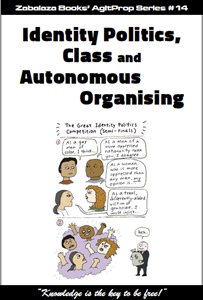 Author: Timothy | File size: 200 KB
This talk is at a midpoint between being an original work, and being an exegesis of Selma’s James justly famous “Sex, Race and Class.” This astonishingly brilliant work contains within itself the clear foundations of a historical materialist, or Marxist, conception of the relationship between capitalism and oppression. Because I have mixed in many of my own original points, both intentionally and no doubt by accidental misinterpretation, I would strongly suggest everyone here goes and reads the original.
 Author: Stephen D’Arcy | File size: 350 KB
“If a handful of time-travelling activists from our own era were somehow transported into a leftist political meeting in 1970, would they even be able to make themselves understood? They might begin to talk, as present-day activists do, about challenging privilege, the importance of allyship, or the need for intersectional analysis. Or they might insist that the meeting itself should be treated as a safe space. But how would the other people at the meeting react? I’m quite sure that our displaced contemporaries would be met with uncomprehending stares…”
Found on the website of The Public Autonomy Project
 Author: Andrea Smith | File size: 328 KB
“In my experience working with a multitude of anti-racist organising projects over the years, I frequently found myself participating in various workshops in which participants were asked to reflect on their gender/race/sexuality/class/etc. privilege. These workshops had a bit of a self-help orientation to them: “I am so and so, and I have x privilege.” It was never quite clear what the point of these confessions were. It was not as if other participants did not know the confessor in question had her/his proclaimed privilege. It did not appear that these individual confessions actually led to any political projects to dismantle the structures of domination that enabled their privilege…”
This article is from the blog of Andrea Smith.
It was found on the website of Miami Autonomy & Solidarity
 zabalazabooks.net