People’s Power, Workers’ Control and Grassroots Politics in South Africa: Rethinking Practices of Self-Organisation and Anti-Apartheid Resistance in the 1980s

People’s Power, Workers’ Control & Grassroots Politics in 1980's South Africa

Authors: Lucien van der Walt, with Sian Byrne and Nicole Ulrich,
Jonathan Payn and Daria Zelenova

File size: 1.2 MB

Download PDF

This special section (#) features three lightly edited transcripts of presentations at a workshop hosted by the International Labour Research & Information Group and the Orange Farm Human Rights Advice Centre in the Drieziet extension, Orange Farm squatter camp, south of Soweto, South Africa, on 24 June 2017. It was attended by a hall full of community and worker activists, including veterans of the big rebellions of the 1980s.

# This piece originally appeared in the Anarcho-Syndicalist Review, No. 71 (Fall 2017)

Continue reading

Building a Revolutionary Anarchism

Building a Revolutionary Anarchism - Colin O’Malley

Author: Colin O’Malley

File size: 384 KB

Download PDF

This article speaks on the failures of the anarchist movement to grow, despite numerous social movements, and how models of anarchist political organisation point the way forward to overcome these pitfalls.

Two recent events have thrown critical challenges at the anarchist movement in the United States: the financial crisis that began in 2008 and the Occupy Wall Street (OWS) movement that sprung from that crisis in 2011. If the current political and economic outlook in this country is any indication, we should expect more frequent moments like these to arise. “Movement Moments” such as these are critical opportunities for revolutionaries of any variety, left or right. Acceptance of the status quo seems impossible.

This piece originally appeared in Perspectives on Anarchist Theory, No. 27 (2014) published by the Institute for Anarchist Studies.

Continue reading

The Deepening Capitalist Crisis: From Blood and Dirt to much worse

The Deepening Capitalist Crisis - Shawn Hattingh [ZACF]

Author: Shawn Hattingh

File size: 349 KB

Download PDF

It was long ago stated that capitalism came into the world dripping in blood and dirt, from every pore, from head to toe. While it has demonstrated that it won’t simply collapse under its own weight, the recent goings-on around the current capitalist crisis have shown that with age it has become even more hideous. Capitalism is now rank with massive state intervention required to simply keep its rotting body moving: through states propping up the financial sector and deepening the colossal attack on the working class.

Shawn Hattingh is a member of South Africa’s
Zabalaza Anarchist Communist Front
www.zabalaza.net
This text from the Anarkismo site.
www.anarkismo.net

Continue reading

AgitProp #20 – The Philosophy of Atheism

AgitProp 20 - The Philosophy of Atheism - Emma Goldman

Author: Emma Goldman

File size: 586 KB

Download PDF

To give an adequate exposition of the philosophy of atheism, it would be necessary to go into the historical changes of the belief in a Deity, from its earliest beginning to the present day. But that is not within the scope of the present paper. However, it is not out of place to mention, in passing, that the concept God, Supernatural Power, Spirit, Deity, or in whatever other term the essence of Theism may have found expression, has become more indefinite and obscure in the course of time and progress. In other words, the God idea is growing more impersonal and nebulous in proportion as the human mind is learning to understand natural phenomena and in the degree that science progressively correlates human and social events…

First published in February 1916 in Emma Goldman’s
Mother Earth journal.

Continue reading

The Principles of Anarchism

The Principles of Anarchism - Lucy Parsons

Author: Lucy Parsons

File size: 321 KB

Download PDF

A lecture by Lucy Parsons, in which she
outlines her views on anarchism.

It was during the great railroad strike of 1877 that I first became interested in what is known as the “Labour Question.” I then thought as many thousands of earnest, sincere people think, that the aggregate power, operating in human society, known as government, could be made an instrument in the hands of the oppressed to alleviate their sufferings. But a closer study of the origin, history and tendency of governments, convinced me that this was a mistake; I came to understand how organised governments used their concentrated power to retard progress by their ever-ready means of silencing the voice of discontent if raised in vigorous protest against the machinations of the scheming few, who always did, always will and always must rule in the councils of nations where majority rule is recognised as the only means of adjusting the affairs of the people. I came to understand that such concentrated power can be always wielded in the interest of the few and at the expense of the many. Government in its last analysis is this power reduced to a science. Governments never lead; they follow progress. When the prison, stake or scaffold can no longer silence the voice of the protesting minority, progress moves on a step, but not until then.

Continue reading

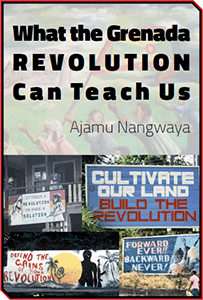
What the Grenada Revolution Can Teach Us

What the Grenada Revolution Can Teach Us - Ajamu Nangwaya

Author: Ajamu Nangwaya

File size: 288 KB

Download PDF

The collapse of the Grenadian Revolution on Oct. 19, 1983 should be carefully examined for the lessons that it might offer to organisers in the Caribbean who are currently organising with the labouring classes. If the working class shall be the architect of its liberation, the process of revolution-making should enable them to fulfil that role. Fundamental change should not be the outcome of a vanguard force that usurps the initiative of the people.

What the Grenada Revolution Can Teach Us About People’s
Power 
published 19 October 2016
The Grenada Revolution and Women’s Struggle for
Liberation
published 13 March 2016
Both texts from:
http://www.telesurtv.net/SubSecciones/en/opinion/articles/

Continue reading

AgitProp #19 – Anarchism and Crime

AgitProp #19 - Anarchism and Crime - SolFed

Author: Solidarity Federation

File size: 206 KB

Download PDF

Anarchists are repeatedly accused by our detractors of being idealist, utopian and impractical. One matter, on which the libertarian perspective is often seen as particularly weak, is the thorny topic of crime. It would be fair to say that the “all coppers are bastards”-type polemics trotted out with tiresome regularity do little to convince the potential convert that revolutionaries have anything of substance to offer as an alternative to the crime ridden status quo. Moreover, this continued failure to adequately address lay people’s basic questions with satisfactory answers surely goes a long way in explaining why contemporary anarchism has failed to gain a firm foothold in the collective psyche of the population. Here we offer one contribution towards addressing this perennial shortcoming.

From Direct Action, Issue #46, magazine of the Solidarity Federation
www.direct-action.org.uk

Continue reading

AgitProp #18 – Feminist Class Struggle

AgitProp 18 - Feminist Class Struggle - bell hooksAuthor: bell hooks   |   File size: 568 KB

Download PDF

Class difference and the way in which it divides women was an issue women in the feminist movement talked about long before race. In the mostly white circles of a newly formed women’s liberation movement the most glaring separation between women was that of class. White working-class women recognised that class hierarchies were present in the movement. Conflict arose between the reformist vision of women’s liberation which basically demanded equal rights for women within the existing class structure, and more radical and/or revolutionary models, which called for a fundamental change in the existing structure so that models of mutuality and equality could replace the old paradigms. However, as the feminist movement progressed and privileged groups of well-educated white women began to achieve equal access to class power with their male counterparts, feminist class struggle was born.

Text from the website of the North-eastern Federation of Anarchist Communists.
See: www.nefac.net

Continue reading

Communism: What’s in a Word?

Communism: Whats in a Word - Paul BowmanAuthor: Paul Bowman | File size: 350 KB

Download PDF

This article opens by looking at how the meaning of communism as opposed to socialism evolved in the late nineteenth century and closes with a look at how this applies to the free software movement today. The terms socialism and communism appear in England around the 1820s as terms adopted by members of the co-operative movement who were sick of hearing their politics referred to as “Owenism”. Originally the two terms were undifferentiated but by the 1840s communism was used by revolutionaries to differentiate themselves from reformists such as J. S. Mill who had adopted socialism to cover an indigestible mess of reformisms.

From Red and Black Revolution, the theoretical magazine of the
Workers Solidarity Movement, #10, Jan/Feb 2005
http://www.wsm.ie/c/red-black-revolution-10

Continue reading

AgitProp #17 – Some Ideas for Community Action

AgitProp 17 - Some Ideas for Community ActionAuthor: Unknown   |   File size: 179 KB

Download PDF

These are a few ideas which are open to being added to, changed, and adapted to reflect the needs of particular communities.

Despite the efforts of politicians and professionals to lump together working class communities as problem areas to be policed, those of us who live in these communities often see things differently. For us the problems we encounter daily are often not of our own making. Poverty, inadequate housing and crime are problems that come with the way society is structured. By taking control of our own communities, and deciding for ourselves how we should manage them, we are not only getting rid of the parasites who cause our problems but also starting on the path to a new type of society where each of us can be free to live our lives as we choose.

Republished from Zabalaza: A Journal of Southern African Revolutionary Anarchism, #4, online at:
http://zabalaza.net/2003/06/04/zabalaza-4-june-2003/

Continue reading