Author: Warren McGregor
PDF File Size: 952 KB
Author: Warren McGregor
PDF File Size: 952 KB

Author: Juan Carlos Mechoso of the Uruguayan Anarchist Federation (FAU), interviewed by Felipe Corrêa
English translation: Jonathan Payn, Johannesburg, South Africa, 2020
PDF File Size: 400 KB
This interview with Juan Carlos Mechoso of the Uruguayan Anarchist Federation (FAU) – conducted by Felipe Corrêa – discusses FAU’s “strategy of especificismo”. Relevant topics are addressed in the questions, such as: the concept of especificismo, this type of anarchism’s relationship with the classics and with similar experiences that have emerged in history, especifismo’s relation with the Latin American context, comparisons with other ideologies that promote operating at distinct levels (party – mass movement), scientific concepts, ideology and its relation to socialism, programmatic positions that anarchists should defend in popular movements, concepts and conceptions of class, neo-liberalism, the development model of Latin American, popular power, strategy, armed struggle and social revolution.
Author: Universidade Popular / Movimento dos Trabalhadores Desempregados (MTD-RJ) (Movement of Unemployed Workers) [Brasil]
English translation: Jonathan Payn, Johannesburg, South Africa, 2020
PDF File Size: 432 KB
This booklet, called Capitalism, Anti-Capitalism and Popular Organisation, is a publication of the Popular University of Rio de Janeiro in conjunction with the Movement of Unemployed Workers of Rio de Janeiro (MTD-RJ).
Formed in mid-2007, the Popular University believes in the political, social and cultural self-education of male and female workers (homeless, landless, unemployed, street vendors, etc.) with a view to building a new society based on socialism and freedom. It is made up of students and workers who assert themselves as the real producers of the wealth of the current society and ,“indignant with the most complete situation of misery and oppression that affects us”, has the “deepest desire for the collective construction of a new society, based on co-operation and equality. ” [Pro-Popular University Manifesto]
Author: Friends of Durruti
PDF File Size: 497 KB
Revolutions without theory fail to make progress. We of the ‘Friends Of Durruti’ have outlined our thinking, which may be amended as appropriate in great social upheavals but which hinges upon two essential points which cannot be avoided. A program, and rifles.”
— El Amigo del Pueblo,
No. 5, July 20, 1937.
Author: Georges Fontenis
File Size: 331 KB
The Manifesto of Libertarian Communism was written in 1953 by Georges Fontenis for the Federation Communiste Libertaire of France. It is one of the key texts of the anarchist-communist current.
It was preceeded by the best work of Bakunin, Guillaume, Malatesta, Berneri, the Organisational Platform of the Libertarian Communists * written by Makhno, Arshinov and Matt, which sprang from the defeats of the Russian Revolution, and the statements of the Friends of Durruti, also a result of another defeat, that of the Spanish Revolution.
Author: Group of Russian Anarchists Abroad (“Delo Truda” Group)
File Size: 436 KB

Author: Lucien van der Walt
File Size: 1.7 MB
This is a book about the history of anarchism. It is a history of nearly 120 years of unbroken workers struggle. It is a history of sacrifice and bravery by ordinary people fighting for a world without bosses and oppression.
Authors: Jonathan Payn, Jakes Factoria, Tina Sizovuka and Warren McGregor
File Size: 443 KB
This pamphlet is a collection of articles exploring the concept, history and anarchist/syndicalist approaches to United Fronts – and their relevance and potential for building working class unity in South Africa – written in the context of the National Union of Metalworkers (Numsa)’s resolution, following its historic 2013 Special National Congress, to break with the ANC-led Alliance and form a ‘United Front against neoliberalism’
Author: Lucien van der Walt
File Size: 293 KB
Trade union renewal is high on the agenda in many countries, but we need to think carefully about why we want it. Union renewal is a profoundly political and ideological issue.We need to have a clear understanding of how we got into the current mess where many unions are bureaucratic, inefficient and struggle to respond to urgent issues. We need to think carefully about what we want to achieve, not just in terms of how we organise – but what we aim at in the long run.
![[Leaflet] Tearing Racism up from its Capitalist Roots - Bongani Maponyane cover](https://zabalazabooks.net/wp-content/uploads/2019/07/leaflet-tearing-racism-up-from-its-capitalist-roots-bongani-maponyane.gif)
Author: Bongani Maponyane (ZACF)
File Size: 126 KB
Racism has been a curse in South Africa, and remains embedded in the society. But how scientific are racist ideas? Where do they come from? And how can we fight racism and create a truly equal and fair society? What do we as revolutionary anarchists think?

Author: Ercan Ayboga
File Size: 331 KB
Ecology is one of the three pillars of the paradigm of Democratic Confederalism, the political-theoretical concept of the Kurdish Freedom Movement. Besides democracy and gender liberation, ecology has been mentioned explicitly as a dimension in this concept since 2005. However to date, ecology is less discussed and practiced than the two other pillars.
Author: Leroy Maisiri
File Size: 326 KB
The purpose of this pamphlet is giving a coherent, comparative analysis on how anarchists and Marxists view the concept of “class,” and the political implications of each approach. Class is the nucleus of both Marxism and anarchism; however the conceptualisation of class is different for both. In pointing out these differences, it is my hope that I will convincingly show how and why the anarchist conceptualisation of class is more comprehensive and more useful, providing a more holistic analysis of many related aspects of class, and a more practical political guide.
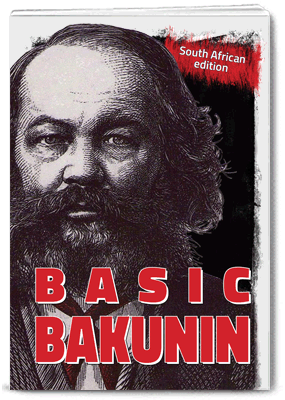
Authors: Colin Parker (with an introduction to the South African Edition by Lucien van der Walt)
File Size: 407 KB
This pamphlet provides an excellent introduction to the ideas of Mikhail Bakunin, the “founder” of anarchism… We do not see Bakunin as a god who never made mistakes. Of course he was not perfect. He was a man, but a man who gave his all for the struggle of the oppressed, a revolutionary hero who deserves our admiration and respect. From Bakunin, we can learn much about revolutionary activism. We can learn even more about the ideas needed to win the age-old fight between exploiter and exploited, between worker and peasant, on the one hand, and boss and ruler on the other…

Author: Lucien van der Walt
File Size: 995 KB
This commentary, an input at a Globalization School debate in Cape Town, engages current labour and Left debates on building alternatives, drawing on the experiences of the radical wing of the anti-apartheid movement in South Africa, and on anarchism and syndicalism. It argues for a strategy of bottom-up mobilization based on debate and pluralism, and building structures of counter-power and a revolutionary counter-culture that can prefigure and create a new social order. The aim is to foster a class-based movement against exploitation, domination, and oppression, including national oppression, that can win reforms through self-activity, unite a range of struggles against oppression, and develop the capacity and unity needed for deep social change. This should be outside parliament, the political party system and the state. The outcome, ultimately, would be the replacement of capitalism, the state, and social and economic inequality, by a universal human community based on self-management, the democratization of daily life, participatory economic planning, and libertarian socialism.
 zabalazabooks.net